Sunday, December 16, 2012

Golden Verses for the Holidays

Pythagorean's Hymn to the Rising Sun
Fyodor Bronnikov - 1869

At this time of year, many of us take time to reflect on the past, our actions and experiences. We watch A Christmas Carol and read about Ebeneezer Scrooge and contemplate what it means to lead a good life, a charitable life, a life that will make a measure of difference to those around us.

This is not a new way of thinking, nor a strictly Christian mindset. Charles Dickens told a fantastic, inspirational tale but the morals in it are not necessarily products of his age. 

Recently, I have been doing a bit of research on Pythagoras and came across the Golden Verses. These are a series of seventy-one rules for living that were popular from antiquity and into the middle ages. It is presumed that these verses were what dictated the way of life for Pythagoras and his followers, known as Pythagoreans.

Most people today think of mathematics when they hear the name of Pythagoras, the Pythagorean Theorum having haunted many a youth in their school days, especially those not inclined to enjoy arithmetic. Myself included.

What many may not know is that Pythagoras was also a philosopher and mystic who influenced later philosophers, including Socrates and Plato.

Pythagoras of Samos
Pythagoras was from the island of Samos which he left in c.531 B.C. to settle in Croton, southern Italy (then, Magna Graecia). In Croton, he established a religious community. They believed in reincarnation and refused to offer sacrifices to the Gods, though they believed in and worshiped the Gods.

Pythagoras died in Metapontum (in modern Apulia, Italy) in c.497 B.C.  and from then, the Pythagoreans spread throughout the Greek world to spread his teachings, the Golden Verses among them.
The list of Golden Verses is quite long so I won’t list them all here. To read the entire list check out this Wikipedia link.

As I said, this time of year is a time when we reflect on our actions and experiences. It has been a sacred time of year for many cultures and religions for millennia. So, in the spirit of Christmas, Yule Tide, Saturnalia and other sacred feasts around the Winter Solstice, here are a few of Pythagoras’ Golden Verses that stand out to me.

1 – First worship the Immortal Gods, as they are established and ordained by the Law.
5 – Of all the rest of mankind, make him your friend who distinguishes himself by his virtues.
7 – Avoid as much as possible hating your friends for a slight fault.
11 – Do nothing evil, neither in the presence of others, nor privately;
12 – But above all things respect yourself.
13 – In the next place, observe justice in your actions and in your words.
18 – Support your lot with patience, it is what it may be, and never complain at it.
19 – But endeavour what you can to remedy it.
20 – And consider that fate does not send the greatest portion of these misfortunes to good men.
27 – Consult and deliberate before you act, that you may not commit foolish actions.
32 – In no way neglect the health of your body;
33 – But give it drink and meat in due measure, and also the exercise of which it needs.
35 – Accustom yourself to a way of living that is neat and decent without luxury.
40 – Never allow sleep to close your eyelids, after you went to bed,
41 – Until you have examined all your actions of the day by your reason.
42 – In what have I done wrong? What have I done? What have I omitted that I ought to have done?
43 – If in this examination you find that you have done wrong, reprove yourself severely for it;
44 – And if you have done any good, rejoice.
66 – And by the healing of your soul, you will deliver it from all evils, from all afflictions.
69 – Leave yourself always to be guided and directed by the understanding that comes from above, and that ought to hold the reins.

There you have it. A bit of wisdom whispered to us across the ages. Whatever we glean from Pythagoras’ words, we can be sure that a life lived with kindness, charity and honesty is indeed a good life and something to be grateful for.

Happy Holidays!

Saturday, December 8, 2012

Writing Alexander


Alexander the Great
I don’t often write about my book projects until they are completed. Perhaps it is a sort of superstition, a fear that if I talk about it prematurely, it won’t happen. There is so much that goes into the writing of an historical novel, let alone a trilogy. With this one, I feel as though I have taken on the Titan of all subjects: Alexander the Great.

My own expectations are high, perhaps unreasonably so, but it is a story that I have wanted to tell for a long time. I feel like Atlas with the weight of the world upon my shoulders and I won’t be shrugging it anytime soon. This is a long-term project, a campaign to the ends of the earth with an historical figure who was as big as they came. I grew up not only with the name (middle) but with the stories. Whenever I would read history, there was always some reference to Alexander, his deeds, or some later personage wanting to emulate him be it Julius Caesar or Napoleon. Generals throughout history have wanted to be Alexander, they have studied him (and still do), his genius, his persona, his propaganda, his tactics, his personal life.

Every aspect of Alexander the Great has been studied over the centuries and yet, it seems like nobody can really know him. He is one of the biggest enigmas of history and so, a dream for any historical novelist willing to take him on.

The Alexander Mosaic from Pompeii
He is the ‘marquee character’ (a term I have heard many agents and publishers use) of historical fiction. That certainly is true but which Alexander will people write about? There are so many. There is the son of a doting, sometimes scheming mother, the mortal son of an angry but brilliant general. There is the merciful man, kind towards women, but often brutal towards his enemies. There is also the genius tactician, the lover, the poet, the scholar, the megalomaniac, the Persian ‘Horned One’, and there is the god. There are other Alexanders too and the more I research and write, the more I realize that there is no possible way I can fully and satisfactorily get into that mind.

For the Alexander novels, I decided to get at Alexander through his men. The Alexander I am interested in discovering is the one that men followed to the ends of the earth, the man that inspired his troops to do the impossible at every turn. Few people in history have inspired their followers in such a way and that is the focus of my campaign to discover and get to know this larger-than-life character.

There are of course, some remnants of superstition clinging to me so I will not reveal the whole of my plot. However, I will say that the main character is named Hanbal son of Akil. He is an Egyptian horse breeder-turned-assassin who has lost everything to the Persians. He is angry, bent of vengeance and, by painful means (I know, too cryptic), he ends up in Alexander’s army.

Siwah Oasis
The first book of the trilogy begins with Alexander’s liberation of Egypt and the young king’s journey to the oracle at Siwah in the western desert. For those of you who know the history, this is a turning point for Alexander. It is also a time when Hanbal becomes acquainted with the men and women who surround the king, Ptolemy, Craterus, Nearchus and the rest of the Companions.

These are big names and I have to admit, it is utterly daunting. But it is also very exciting to weave the fiction in with history. That is why I love writing historical fiction.

The primary sources I have decided to focus on are those texts that Alexander would have been influenced by such as Homer and Xenophon. The latter’s ‘Anabasis’ was used by Alexander as a field guide when marching into Persia. Primary sources on Alexander himself are of course, Arrian and Curtius who both have their own style and focus.

As far as secondary sources, there are so many books that have been written on Alexander the Great, there is no way I could cover them all. And let’s face it, story has to come first in fiction. I have several secondary works on Alexander but the one that has proved most useful is my old copy of ‘Alexander’ by Robin Lane Fox. For those of you who are interested, this is a fantastic, accessible and interesting biography of Alexander.
Oliver Stone's Alexander - Battle of Gaugamela scene

I will post updates on the project as I go. I am almost finished the first draft of the first book which I am writing long-hand whenever I can. However, I have one major event yet to write: the Battle of Gaugamela.
Gaugamela is one of the major battles of history and it displays Alexander’s military genius to perfection. So how can I do it justice? I think many writers feel like this at times and this certainly is the time for me. For now, more research is required to attain comfort. I’ll take my time getting there and wait for the opportune moment to jump into the fray. Like Alexander, I can see the battle waiting for me on the other side of the Tigris.

The drums of war are ringing in my ears and I must write on…

Sunday, December 2, 2012

IMMORTUI – Fighting the Undead – Mithras, Lord of Light

"Hear us great Father of Light! Receive our thanks for delivering us from the dark." (Gaius Justus Vitalis; IMMORTUI)
Relief of the Tauroctony

In the ancient world most people believed in the gods, believed that the gods played a role in all aspects of life. Whether it was a major battle to decide who would rule the known world, or something as simple and mundane as keeping a person safe on a journey to the next town. People, one could say, held their gods close on a daily basis. Not just once a week or at the holidays.

For the men serving in Rome’s legions, as in IMMORTUI, there was one god to which many turned when they faced death on an almost daily basis: Mithras.

For Gaius Justus Vitalis and his men, Mithras is the light with which to combat the dark on the edge of empire. But who was this strange god who was relatively new to the Roman Pantheon?

Ahura Mazda on the ruins of Persepolis
Mithras originated as an ancient Persian god of Truth and Light whose cult was an offshoot of Zoroastrianism, the ancient Persian religion, which recognized Ahura Mazda as sole creator of the universe. In mythology, Mithras supported Ahura Mazda in a struggle against the evil Ahriman. This struggle of Good/Light vs. Evil/Darkness is at the heart of Mithraism.

Mithras was sent by Ahura Mazda to hunt and kill the ‘divine bull’ and from the bull’s blood, all life sprang. This is the creation myth of Zoroastrianism and the ‘Tauroctony’, the slaying of the bull, is the central image, the greatest rite, of Mithraism. When Mithras captured the bull, he is said to have taken it to a cave and there, slain it. That is why most Temples to Mithras were in caves, or dark rooms made to look like caves. Over time, because of his identification with the Light, Mithras also became identified with the sun, and altars to Sol Invictus, the ‘unconquered sun’, were associated with his worship.

The cult of Mithras seems to have come to Rome in the second half of the first century B.C., likely encountered by Roman soldiers who had been campaigning in the east with Marcus Licinius Crassus and Mark Antony against the Parthians.

Mithraeum, beneath San Clemente, Rome
Mithraism was one of the ancient ‘mystery religions’. These were religious cults in which initiates swore a solemn oath not to reveal the rites and activities involved. As a result, very little is actually known. Other mystery religions of the ancient world included the Elefsinian Mysteries (dedicated to Demeter and Persephone), the cult of Isis (the Egyptian goddess worshipped as mother/wife, patroness of nature and magic, and friend of slaves, sinners, artisans and the downtrodden), and the cult of Serapis (Hellenistic god intended to merge the Greek and Egyptian religions).

Mithraism was different from the other mystery religions in that it was for men only. During the Roman Empire its appeal had grown so much that Mithraea (dimly lit temple-caves or rooms) could be found outside of Roman forts across the whole of the empire. Why was this, a foreign religion, so intensely popular among the eagles of Rome?

Some believe that Mithraism may have appealed more because of its stronger promise of an afterlife and more personal relationship with the god. Understandable when one is facing death regularly. Also central to the religion were the attributes of Strength, Courage and Endurance which would have been highly valued by the soldier-adherents.

Mithras as Sol Invictus
In IMMORTUI, Gaius Justus Vitalis is referred to as the Heliodromus or ‘Sun Runner’ which was his grade or rank in the cult. In Mithraism there were in fact seven grades of initiation each associated with a deity. These were (from lowest to highest): Corax (Mercury), Nymphus (Venus), Miles (Mars), Leo (Jupiter), Perses (Luna), Heliodromus (Sol), and Pater (Saturn). Each of these grades was also associated with a particular symbol such as a torch for the Heliodromus, or a mitre for the Pater. Did the rites involve the use in some way of these symbols for each of the initiates? Perhaps. There is no way to know for certain. What is known is that these symbols appear on many of the elaborate carvings that have been found. They are full of symbolism, as is much of ancient and medieval art.

Mithraism was, however, not just a religion, it was a very close-knit society, a sort of club. Much as members of the Masonic Order, initiates of the Mithraic mysteries likely helped their brothers to advance and helped them in times of need. There would have been an understanding among them that they were not alone, that each was there for the other. It was a strong network across the empire.

Mithraic symbols and the Tauroctony
It has been hypothesized that Mithraism was the precursor of Christianity, not only because of its monotheistic nature and the battle between Light and Dark (which is universal) but also for the inclusion of such rites as baptism and a ritual meal. The date associated with the birth of Mithras is also December 25. It is a very interesting idea and may, partially, explain the widespread integration of Christianity in the later empire.

In IMMORTUI, Gaius Justus Vitalis and his men find rejuvenation in the Mithraic rites. They know that as they head into the darkness of the Carpathian mountains to face the terror of an unknown enemy, they will not be alone. The Light will guide them and, if they are to die, there is something bright beyond the black river that awaits them. For Gaius himself, faith shall be reinvigorated at the darkest of hours. What will happen to him? Will Light overcome Dark?

You will have to read IMMORTUI to find out.
Remains of the Mithraem at Carrawburgh, along Hadrian's Wall

----------------------------------------------------------------------------------------------------------------------------------

This is the final installment looking at the world of IMMORTUI.

In 2013, keep a lookout for Carpathian Interlude – Part II in which the Empire will face one of its most dangerous foes yet.

If you are interested in picking up IMMORTUI, it is available as a $.99 cent novella from Amazon, iTunes, Kobo, Barnes and Noble and most other online retailers. You can also use the links on the right-hand side of this blog.

If you have already read IMMORTUI, do post a review of it on whichever site you purchased it from. Reviews are a great help to independent authors and go a long way to helping produce more work for you to enjoy.

Cheers!

Sunday, November 18, 2012

Gladiator Games, Past and Present

I’ve touched on this subject before but have decided to come back to it with some questions rather than answers.

Why were gladiatorial games and bloodsports so popular in the Roman Empire?

What sparked this question again for me was reading The Sun Also Rises, by Earnest Hemingway. Not ancient history, true, but it does have passages about the running of the bulls and bull fights in Pamplona, Spain. Of course, I am aware of the Pamplona festival and bull fights which are a remnant of the ancient events of the amphitheatre. A matador may not be Spartacus but he certainly has cojones. Reading about Pamplona got me to Googling some photos of the festival which led me to one thought:

People are fu#*ing crazy!

Pamplona goring
Excuse the (sort of) expletive but, when writing, you must always strive to use the best word possible and that seemed most fitting. I’m sure it’s an adrenaline rush being chased down with the easy chance of being gored but, really? The runners don’t have swords like the matadors. Have a look at some of the photos I found – OUCH!

And yet, people continue to do it, to watch it. I suppose it is way more ‘manly’ to face down a bull with a sword (or run from one) than to shoot a lion or moose from 100 meters with a gun. The latter is no test of strength in my opinion. Get in the ring with a lion and a knife in your hand, then you’ll be brave, or at the very least off your head.

I digress.

Gladiatorial Combat
In ancient Rome, the populace flocked to amphitheatres all over the Empire to see men die and animals slain, people tortured, burned, raped and all manner of horrific things. Emperors and other officials put vast fortunes into these events, importing animals from distant lands, in order to please the mob and exert control over it. With the mob behind you, you had real power. That was the way in ancient Rome.

 But what about today? Why is bull fighting, boxing or, an even better example, why is Ultimate Fighting Challenge, so popular? The latter is not the phony, chair swinging, airborne drop-kicking show of the WWF any more. These guys are in the ring beating the hell out of each other while people in bars across the world sip drinks and watch and cheer and hope for the mischance that will make it all the more exciting.

If history has taught us anything, it is that violence is inherent to human nature. Even though people feel disgusted or repelled by something horrific, much of the time, they feel the urge to look, to gawp. Is it like watching an awful talk show where the people on the stage are so far gone that it makes the viewer feel better about their own life? Are we ok watching because the people are strangers to us? Would we feel differently if we knew the person? The need for violence, to watch it, must go deeper than that. Why then does not everyone wish to witness it? Maybe it comes down to one’s constitution, that some are just more able to handle the sight of it?

Ultimate Fighting Challenge
Primary sources from ancient Rome differ in their views of the games in the Coliseum. Some people saw it as a rite of passage for young men, that it was good for them, would toughen them up. Others viewed the games as something base, something that undermined a great civilization. I think camps are divided today as well.

What about the moral dilemma facing the practice and viewing of bloodsports? Is not the mark of true civilization that we strive for goodness in every aspect of life? I suppose it depends on your perspective.
I don’t have an answer and I’m sure there are a plethora of sociological and psychological theories on violence in ancient and modern times. It is just something that perhaps we should think about next time our eyes search an accident scene as we drive by, or the next time we turn on the television to watch some stranger have his face turned to pulp.

In ancient Rome, the games were not only a showcase for the powers that be, they were an occurrence in which the populace would be brought together to share in something alongside their rulers. Even in hindsight, it is difficult to fully understand the appeal. But the games lived on for hundreds of years, having made the transition from funerary rite to public display for the entertainment of all.

Pamplona misfortune
I have not been to a modern bull fight myself, and I don’t know that I would want to. Hemmingway describes it as only he can, simply, without any romantic notions. It is a powerful scene, and yet, despite being the literary ‘tough guy’ that he was, he does cast doubt on the whole idea of running with the bulls and bull fights when the character of Jake is speaking with a waiter at a café after the morning’s events.

The waiter asks if anything happened at the running that morning and Jake tells him that one man was badly gored. One would expect the waiter, a local who makes money off the festival, to be a fan of the running of the bulls, the fights. And yet, as Jake tells him about the man getting a horn through the back and out the chest, he shakes his head and says:

“All for sport. All for pleasure… You hear? Muerto. Dead. He’s dead. With a horn through him. All for morning fun… Not for me… No fun in that for me.”

I think I’m with the waiter on this.

Scene from Spartacus: Gods of the Arena
And yet, I enjoy watching movies or TV series such as Spartacus: Blood and Sand which contain extremely graphic depictions of gladiatorial combat and violence. Why is that? For myself, the fact that I know it is not real, that those things are not actually happening to people, is a big factor. As a fiction writer and historian, I like to be transported to those times and places I have studied for so long. It fires my imagination and, Spartacus is just great storytelling.

If I were a young citizen in ancient Rome, would I find myself at the amphitheatre, yelling for a victor to slit the throat of a fallen foe? Perhaps. They were different times, far removed from our modern mindset. I know I wouldn’t want to see that today. I think I would much rather find myself in the Circus Maximus taking in the chariot races. But that’s just me.

I guess the danger is in taking violence for granted and not recognizing it for what it is. Whether it is the Ultimate Fighting Challenge, bull fighting or representations of gladiatorial games in ages past, we should stop and ask ourselves why we are watching it, participating in it, and why we enjoy it. 

Sunday, November 11, 2012

Remembrance Day


The 11th of November is upon us once more and red poppies are bursting out from black coats as they move about on autumn sidewalks. On Remembrance Day (formerly Armistice Day) not everyone will be wearing a poppy, of course, but many will. This is a time of year when we pay tribute to warriors, past and present, their families and all the other men and women behind the scenes, at home and on foreign fields.

For many however, the idea of war seems remote, a thing of the past, of history. “It’s something that happens far away.” But let me tell you, war is not relegated to the ancient world, to the battle fields of Thermopylae, Salamis or Gaugamela. Mars has left his bloody mark on every stage of human history to our present day and, as a result, sacrifice, pain and loss have resonated across time. One cannot always agree with the motives for war but, unless we learn from the past, the bloody cycle of battle will continue to repeat itself.

Millions of men, women and children have laid down their lives over the ages, as combatants or victims.

We would do well to remember them.

I was young when my grandparents passed away and so, did not have a chance to ask about what it was like fighting alongside General Allenby or T.E. Lawrence. I would have liked to know what it was like at sea on a merchant navy ship with German U-boats haunting the depths or how Greek resistance fighters kept faith in the mountains of a land I have only ever known as a sunny holiday destination.

This week I have been reading to my own kids about Remembrance Day and the World Wars. Kids can be quite astute, resilient I find, when it comes to horrible things. But there are also lessons to be learned that can be found not just in fiction. Lessons about honour, courage and sacrifice, beliefs, right and wrong. We read the poem In Flanders Fields and they knew is wasn’t all about flowers. The poem reminds us about sacrifice, that there is beauty in the world, things worth fighting for, be it freedom, goodness or something as simple as a field of red flowers.

This day, of all days, forget about politicians and politics. Instead remember the troops and support personnel, past and present, their families, their lovers, all of them. They are not the ones who decided that war should be waged and that they should be sent to die on foreign soil.

Think of those poor people in war-torn regions who, as I write this, hunker down in a corner of their home, hoping that the next bomb blast does not destroy all they know and love. It is easy to be complacent sitting in our safe homes or behind our desk in a boring office. ‘Lest we forget’ is very relevant today.

So, wear your poppy with memory and gratitude this day, this month. Thank the veteran who is standing by the subway entrance selling little red flowers, for though they may not appear so, they have likely been to hell and back all so that we can walk safely down a quiet sidewalk.

To all of you, from the distant past to the present, Thank You. I remember and I shall not forget.

Saturday, November 10, 2012

IMMORTUI – Fighting the Undead – Roman Armour and Clothing

Optio's helmet

In the previous post, we looked at the main weapons used by Roman troops. However, if you are not clothed and protected, you may not last long on the field of combat. In IMMORTUI, I mention some of the articles of clothing that the characters wear as well as their armour.

Pretend you are a Roman soldier getting dressed for the day or that you are preparing to go on campaign and need to stuff some extra clothing into your satchel which you will have to carry on your back along with two sharpened stakes, pots and a shovel and pick axe. When the Legions were  reorganized and equipment standardized by the General Marius, there was a reason why the men became known as ‘Marius’ mules’!

Tunic
Bracae and Caligae
 The Roman soldier would have a standard issue tunica which was like an over-sized shirt, belted at the waist by a cingulum. You wouldn’t leave without pants or trousers in the morning and neither would a Roman go into battle without bracae which were made of wool, just like the tunic. This basic outfit was completed with a pair of caligae which were standard issue Roman military sandals with hobnails. As an aside, the Emperor Caligula was so nick-named because of the little pair of army sandals he wore as a child. He was called ‘Little Boots’. New archaeological evidence shows that contrary to what was thought, Roman soldiers did in fact wear woollen socks. Makes sense to me; I can‘t imagine trekking through Caledonia or Germania in bare feet. A cloak was also an important piece of the outfit and could serve as a blanket on the march, a shield against the elements.
Phalerae

Cingulum and Pugio
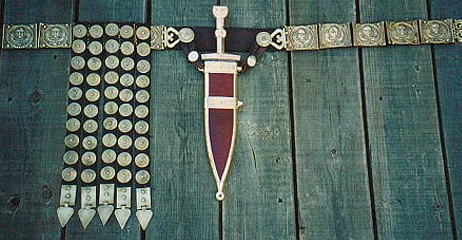
If you were a decorated officer such as a centurion, you would be wearing a leather harness over your chest that was decorated with phalerae, a series of bronze or iron discs with images of gods, goddesses and other symbols that were believed to protect the wearer from harm. Soldiers were notoriously superstitious!


Lorica Segmentata
All that clothing however, is not going to help you if you are not protected by a certain amount of armour. This brings us to the lorica segmentata, the standeard breastplate of the Roman legionary of the Empire. The design of the lorica is ingenious, providing good shoulder, chest and back protection while providing for ease of movement and flexibility due to the segmented style of the steel plates. If you were an auxiliary trooper, you more likely had chainmail. Aside from the leather straps hanging from the soldier’s cingulum, the lorica was the only protection on the torso.

Officer's Pteriges
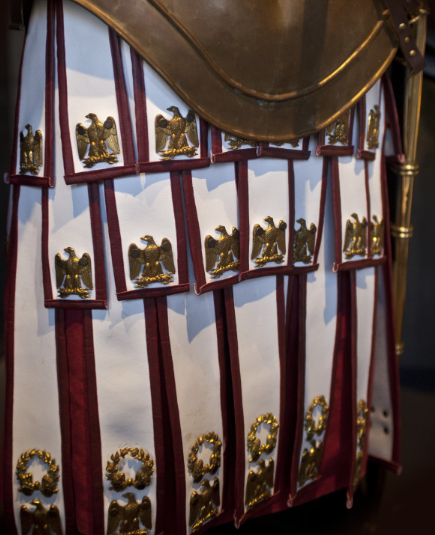
An officer’s armour would vary from the ordinary trooper’s. Commanding officers or tribunes would be wearing a cuirass which was a breast/back plate made of iron and/or hardened bull’s hide, often ornamented with patron gods and goddesses of their family. Beneath these would be a full skirt of leather straps hanging down to the knees called pteriges. A commander may also have worn ornamented greaves which protected the shins but these were often cumbersome and not always in use during the Empire.

Finally, when it comes to protection, few things mattered so much as the helmet. The standard legionary helmet was perfected over hundreds of years, improving upon ancient Greek, Thracian and Macedonian models. There was a rim to protect the face from downward slashes from an enemy, a large, fan-like neck protector at the back, cheek flaps and holes for the ears so that the soldier could hear what was going on.

Centurion's helmet
Helmet crests were used to denote rank as well. For instance, a centurion would be known by the horizontal, horse-hair crest on his helmet where an optio (one step down from a centurion) had a crest going from front to back with feathers on either side of the helmet. A legate or other commanding officer might add a flourish with a very large horse-hair crest and highly ornamented cheek pieces to denote their own rank and wealth. Later on, parade helmets for cavalry prefects and other auxiliary officers included face masks, giving them an otherworldly look.

Auxiliary Cavalry Helmet
There you have it, a quick look at the clothing and armour of the Roman army. Not much to it, but, it was highly effective and utilitarian and certainly gave the soldiers of Rome an edge when combined with their weapons. Whether or not the armour provides enough protection against the undead enemy in IMMORTUI, well, that is another thing entirely.

Keep an eye out for the third and final instalment of the posts looking at the world of IMMORTUI when I will look at the cult of the Roman soldiers’ god, Mithras. 


IMMORTUI - Carpathian Interlude Part I is now available as a $.99 cent novella on Amazon and iTunes. 

Saturday, November 3, 2012

IMMORTUI – Fighting the Undead: Roman Weapons


Salve!

This is the first post in a short series that will be looking at some aspects of the world of IMMORTUI, Part I in the Carpathian Interlude series of novellas.

When Optio Gaius Justus Vitalis and his men set out to confront legions of zombies in a dark valley of the Carpathian mountains, there is one thing that really enables the Romans to hold their own: weapons.

The Roman army was one of the most disciplined, well-organized and well-armed fighting forces of the ancient world and their weaponry evolved over time as they adopted the best from each nation they conquered.

In IMMORTUI, I have tried to use the Latin names for all the weapons and articles of clothing. After all, this is a story, not a history lesson! However, for those of you who may not be familiar with the world and weapons of ancient Rome, here is a crash course in case you ever find yourself facing down legions of undead.

Pompeii style Gladius
First, and most importantly, is the gladius. This is the Roman soldier’s (legionary’s) sword. The word ‘gladiator’ is derived from this word. This weapon has been called the ‘meat-cleaver’ of the ancient world because of its brutal efficiency. It was primarily a stabbing weapon, worn on the soldier’s right side. The style varied slightly from the Republic to the Empire but the effect for each was the same. The gladius was indeed an extremely deadly weapon.

In the ancient world, shields were of primary importance for defending the bearer against all manner of attacks from arrows and sling stones, to cavalry charges and a rush of roaring Celts. The Roman legionary’s shield was called a scutum. This was a very large, heavy rectangular or oblong shield with a large boss in the middle that could be used to smash the face of an attacker. It would protect more than half of a soldier standing up, and was used to great effect in military formations such as the tustudo, or tortoise formation.
Scutum

Pila
What ancient warrior’s kit would be complete without a spear? The Roman solider’s spear was called a pilum. This differed from the spears of the ancient Greek hoplite in that it was much lighter and could be used only once. It was however, very effective at piercing armour and flesh because of its fine point. A hail of these was truly deadly and was the Romans’ first offensive weapon after artillery. And, once thrown, it could not be picked up by the enemy and thrown back due to the special design that ensured the tip broke off or bent upon impact making it useless. 

For an optio, like Gaius Justus Vitalis in IMMORTUI, a hastile was carried instead of a pilum. The hastile was a staff carried by that particular rank of officer and though it was symbolic of his rank it could also be used as a weapon if need be.

Optio carrying hastile
When the fighting inevitably came to close quarter combat, and pila and gladii were spent or lost, the Roman dagger called a pugio was what was called for. This blade, apart from having practical uses such as cutting meat or sharpening a stake, this could be thrust into the side of an enemy when he came too close for comfort. The pugio was worn at the soldier’s left side, secured tightly at the waist for a quick and easy draw.

So there you have it! These are the main weapons of a Roman legionary which they would carry with themselves on the march and into battle. They would never leave his side whether he was sleeping or digging ditches and ramparts at the end of the day.

Roman Pugio
The question you have to ask yourself is whether these weapons, honed and perfected over centuries of use, would be enough to defeat an enemy that feels neither pain nor fear, an enemy that will keep coming at you until you do one thing…

Well, you will have to read IMMORTUI to find out.

Tune in next week for the second post on the world if IMMORTUI in which we will look at Roman armour and clothing.

Legionaries in 'Testudo' formation