Sunday, January 6, 2013

DELOS - A Visual Odyssey

The Sacred Lake of Delos

Leto, the beautiful Titaness, travelled the world over as her belly swelled with the offspring of cloud-gathering Zeus. No town or village, forest or mountain fastness would welcome her with the great goddess Hera pursuing her to the ends of the earth. Rest upon land was forbidden to the expectant mother who fled her tormentors from the great forests of Hyperborea to the salt sea. When Leto’s time was near and the pangs of childbirth could be felt like a tremor in the very depths of Gaia, an island with no roots welcomed her.

Oh sacred Delos, gift to the world of gods and men. Beside the crystal water of your sacred lake, beneath the gently swaying branches of your palm, Leto reached her labour and gave birth to gods. May Artemis, the huntress, and far-shooting Apollo, forever guide pilgrims to your shores that you may never again be lonely in the middle of that wine-dark sea.


Sacred Port and Remains
There are many sacred places in the world, places that have been the centre of worship for ages. They are places where history and myth vibrate together and can be felt, touched.

The Aegean island of Delos is such a place.

This post is not a history lesson. This is more of a visual journey, something for your senses to enjoy. This is something special to share.

At the eye of the group of islands known as the Cyclades, this little island was a centre of religion, inspiration and trade for millennia. Empires went to war over control over this small place just five kilometers long and thirteen-hundred meters wide.

The House of the Dolphins
Delos has been occupied, as far as we know, since the third millennium B.C. As the midway point between the Greek mainland and the western Aegean islands and the Ionian coast, it was the perfect stopping point for ship-bound traders.

However, the main reason for the popularity of Delos, for its sanctity, was that it was believed to be the birthplace of the goddess Artemis and her brother, one of the most important gods of the Greek and Roman pantheons, Apollo.

To reach Delos today you must take a boat from the nearby Cycladic island of Mykonos. It is a choppy ride and not for those without sea legs. The Cyclades are in a windy part of the Aegean. However, the short odyssey to get there is well worth it. Once you come out of the waves and into the Delos Strait between the island of Rhenea and Delos itself, the waters welcome the visitor and Delos appears like a hazy jewel in a brilliant turquoise sea.

Residential District Ruins
Delos is not just another archaeological site to be seen hurriedly through the lens of a camera. For those open to it, as soon as you set your foot on the path from the ancient ‘Commercial Harbour’ to the upper town, you know this place is different. This is a place to be felt with all your senses. Apollo’s sun beats down with intense heat and the hot Aegean winds wrap themselves about you at every turn. The voices of the past are loud indeed, be they of priests or pilgrims, merchants or charioteers, theatre patrons or performers, the rich or poor. Everyone came to Delos for all manner of reasons for thousands of years.

Ruins along the Sacred Way
To preserve the purity of the place in ancient times, it was forbidden for anyone to be born or to die on Delos. Those who were involved in either of these acts were sent across the strait to Rhenea to do so. As the birthplace of two very important gods, this was taken very seriously.

Palm at the Sacred Lake
“…the pains of birth seized Leto, and she longed to bring forth; so she cast her arms about a palm tree and kneeled on the soft meadow while the earth laughed for joy beneath. Then the child leaped forth to the light, and all the goddesses washed you purely and cleanly with sweet water, and swathed you in a white garment of fine texture, new-woven, and fastened a golden band about you.” 
(Hymn to Delian Apollo)

The usual visitor might be led directly to the small museum on-site where several artefacts are on display. Others feel themselves pulled in the direction of the place that made Delos famous. The Sacred Lake, where Leto is said to have laboured for nine days when giving birth to Apollo, is still there with its magnificent palm swaying in the sea breeze. The lake is drained now and the palm is a distant ancestor of the original, but it is still a marvel to stand in a place revered for ages. On a nearby hill, the nine Delian lions stand guard over the birthplace of the gods, ever watchful.

Mount Cynthus
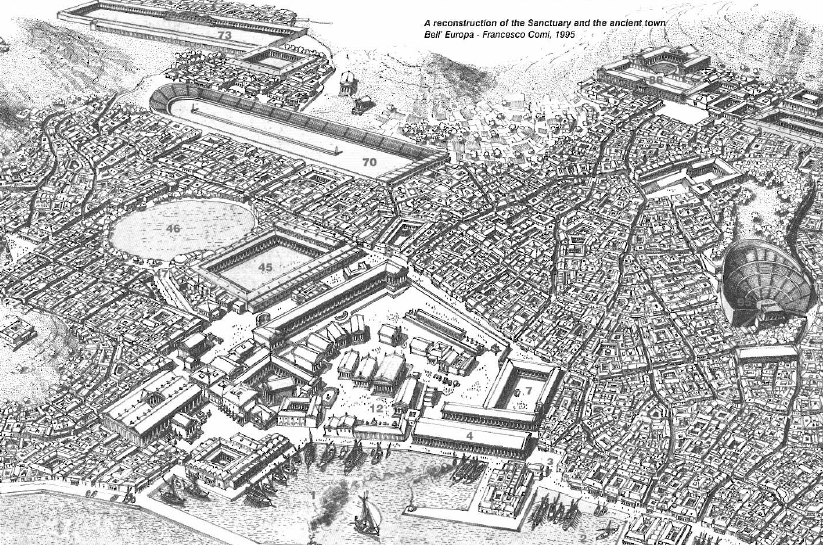
Delos was not just a quiet place for religious reflection. Indeed, it was very busy and at one point had a population of about 25,000 people. It was covered with sanctuaries and temples, monumental gates and colossal statues, stoas, shops, homes, theatres, stadia and agora. And above it all was mount Cynthus, 112 meters high, where the Archaic Temple of Zeus looked down over the birthplace of his children and all the mortals coming to do them homage.

If you stroll about the island you will be greeted by something new around each corner; a different view of the sea, ancient homes with some of the most beautiful mosaics ever found open to the sky, the ruins of a once-beautiful theatre, or even something as simple as a stretch of marble paving slabs from whose cracks red, purple and yellow flowers sprout to paint the scene.

Temple of Isis
Sanctuary of Egyptian Gods
Delos was a meeting place of many deities, not only Apollo and Artemis. There were also temples to Zeus, Athena, Poseidon, Hera and many others of the Greek Pantheon. On the Island of Delos there were also sanctuaries to Syrian, Egyptian and Phoenician deities. Near the stadium area, archaeologists have uncovered the remains of a Jewish Synagogue. All were welcome to make offerings, worship, work and trade on this tiny rock-of-an-island which, by the 1st century B.C., was one of the greatest commercial centres of the world.

As one walks around the site today, it is not necessarily the voices of trade and craftspeople at their daily work that one is reminded of.

The shops have long since closed their shutters and turned to dust. The treasuries have been looted to crumbling. Grass and wild flowers sprout from between the paving slabs of the Sacred Way where asps warm themselves beneath the rays of Apollo’s light.

Delian Lion
In truth, it is difficult to describe in words the feeling one gets while cutting a meandering path among these ancient ruins. Delos is a place of light and colour and ancient beauty, an omphalos of the Aegean to which travellers have been drawn for ages.

For myself, there is an overwhelming sense of awe and absolute peace that creeps over me when I visit this place. It is not always an easy task to shut out the groups of tourist hoards that descend upon this unassuming rock by the boatload. However, if you can manage the journey there, to break away from the masses, you will be treated to an experience in which you will delight in myriad shades of blue and pristine white, hot Aegean breezes and the loving light of the sun.

Most of all, you will stand still and wonder at the sight of a swaying palm, that one spot on the island where gods were said to have been born and which earned this place called Delos renown for all time.

“…queenly Leto set foot on Delos and uttered winged words and asked her… "Delos, if you would be willing to be the abode of my son "Phoebus Apollo and make him a rich temple --; for no other will touch you, as you will find: and I think you will never be rich in oxen and sheep, nor bear vintage nor yet produce plants abundantly. But if you have the temple of far-shooting Apollo, all men will bring you hecatombs and gather here, and incessant savour of rich sacrifice will always arise, and you will feed those who dwell in you from the hand of strangers…”              
(Hymn to Delian Apollo)

The nine Delian Lions keep a timeless watch over the Sacred Lake.

Part of the archeological site of Delos. Excavations continue as most of the island remains to be uncovered.

Terrace of a Delian house overlooking the Commercial Harbour.

Mosaic at the House of the Dolphins.

Doorway to the back of the theatre.

The ancient theatre of Delos. The artistic competitions of the 'Delia' were performed here. 

Island cisterns where rain water was gathered. 

Alleyway among the ruins of Delos.

Mosaic in the residential quarter.

Mosaic waves open to the sky. 

Statues in the House of Cleopatra.

Ruins near the harbour.

Remains of colossal statue of Apollo (the torso).
Artist rendering of ancient Delos - Francesco Comi, 1995.

Map of the Archaeological site of Delos
Edition sponsored by the Hellenic Republic, Ministry of Culture
and the European Community (3rd CSF 2000-2006)

Sunday, December 30, 2012

Happy New Year! Two heads are better than one…


… at least in ancient Rome.

Janus
We come to it at last, the end of the year 2012.

It is time to pass beneath the arch of December and on into January.

I suspect many people, myself included, feel a bit melancholy at this point. The holidays are all but over and back-to-work days are staring us in the face. We consumed inordinate amounts of food, wine, sweets and evening glasses of Bailey’s on ice.

We reflect on the year that is left in our wake and sigh because we must move forward whether we like it or not. Perhaps we did not accomplish all that we set out to do? Let’s face it, the crappy things tend to hold our attention more than the brilliant ones.

The secret to overcoming the New Year blues is to remember the past year whilst moving forward through the next. Like the study of history, if we forget the past, we are indeed doomed to repeat it.

Did you know that the month of January was named after the Roman god, Janus? He was the two-headed god of gates, doors and new beginnings. In ancient Rome, New Year’s Day was dedicated to this two-headed deity who kept one set of eyes on the past year while watching over the year to come.

For Romans, January was a month for looking back and looking ahead.

In Rome, when the two new consuls were to begin their term in office, they would begin on New Year’s Day. Janus would watch over beginnings such as the latter or something as small as the start of a new business venture for a butcher in the Suburan slums of the city. Janus was the first god on the list in prayers and the first to receive a portion of a sacrifice.

Janus watched over all transitions and new beginnings and that is what many of us will be doing this New Year.

Not that we should obsess about how we begin the New Year. We should just be mindful of what has come before and be open to what is approaching us in the yet-to-come.

Temple of Janus
Autun, France
It may be that we were somewhat less than what we wanted to be in recent months but that is the beauty of new beginnings. History is what it is and it is up to us to learn from it.

The future is what we are willing to make of it.

So, maybe the Romans had the right idea? Perhaps the best way to move through the gate of one year into the next is to remember, learn, and then press on with creativity and inspiration and Januvian optimism in all aspects of our lives.

It is not just New Year’s Day or January that are the beginning but each new day that dawns, that sees us awake and thinking, a new opportunity to shine.

So, with that one thought from Writing the Past, I wish you all a brilliant and fortunate future for 2013.

Happy New Year!

Monday, December 24, 2012

History of the Holidays

Holly Wreath


Season’s Greetings everyone!

It is indeed that time of year again. The wheel of time has turned round once more and we find ourselves at the Winter Solstice. It is a time of celebration, of gathering and merry making. It is a time of giving and gratitude. For many of us, it is Christmas time.

I always feel a great connection to the past at this time of year and not only the Christian past. The traditions of this time reach much farther back than the beginnings of Christianity. Over the millennia this very time of year has been held sacred and special by many ancient cultures, celebrated in many different ways.

We have more in common with the past than we often realize.  

As I sit by the tree in my living room, the soft glow of a thousand coloured lights gracing the paper upon which I write, I feel a common thread of tradition with those that have gone before, and those that will come long after I am dust. There is a comfort in that. 

Traditions are important for all people, all cultures. And so, I wanted to look at a few of the varied traditions of this festive season from which most of us derive some form of jollity. 

Marduk
In ancient Babylon the Festival of Marduk, the god whom the Babylonians believed created the world, was celebrated at this time of year. The festival involved a twelve day feast during which time gifts were given and people visited the homes of friends and family. Sound familiar?

In the Roman Empire, the big festival at this time of year, indeed one of the biggest of the entire year, was the Festival of Saturnalia which began officially on December 17. Saturn, of course, was the Roman god of agriculture, of liberation, and of time. Fitting that the Winter Solstice festival, the time when the days would begin to get longer and the winter stores of food were used, was dedicated to him. Time moves on. 

Saturnalia was a major party for Romans. There was always lots of food, drink and gift-giving. Gifts were often small and inexpensive and included things such as lucky fruits or cakes. Saturnalia was a definite carnival atmosphere, especially for slaves for, as Saturn was also a god of liberation, for one day, slave and master exchanged roles with the masters serving the servants. Everyone could let loose. Indoors, many candles were kept burning during this darkest time of year and green boughs were hung within and without people’s homes. 

Saturnalia in Ancient Rome
Many believe the Greek festival of Kronia, a harvest festival dedicated to Kronos in July and August was the major influence on Saturnalia. At the Kronia, there were feasts and banquets and games. There was also freedom from work and social equality for a day which represented a ‘Golden Age’ in which there was total harmony, no slavery or hierarchy. Slaves were released from duties during part of the Kronia just as they were during Saturnalia. 

And of course, as with any ancient festival, offerings and sacrifices were made to the gods. The religious roots of these celebrations cannot be overstated. Ancient peoples believed the gods played a role in every aspect of daily life and each was honoured. That is one reason there were so very many festivals in the Greek and Roman calendars. 

Mithras and the Tauroctony
A couple of blog posts ago, I wrote about Mithras, Lord of Light and Truth, and now we return to him. The Persian god Mithras defeated the darkness for Ahura Mazda and in mythology, his birthday was December 25th. As a god of Light, equated with Sol Invictus, the ‘unconquered sun’, it is no wonder that the Winter Solstice, the time when the sun is reborn after the darkest days, was dedicated to Mithras. Saturn also played a large role in Mithraism as this was the name given to the highest grade of initiate in the religion – Saturn was the ‘Pater’. 

Other pre-Christian gods of light, merriment, and abundance were said to have been born during December as well, including Dionysus and the Hebrew/Phoenician god, Baal. 

Mistletoe
The Winter Solstice was a very sacred time of year and this seems to be the most common thread through time and religions. The worship of the rising Sun, the time when the eternal Sun begins to get higher in the sky, making the days longer, warming our lives. 

At Christmas, I like to hang cedar in our home, as well as boughs of holly. It is beautiful, atmospheric, warm and sweet smelling. It is also a tradition that was practiced by the ancient Celts and Druids for whom nature was so important. 

The Celts believed holly and mistletoe were sacred and that they housed good, protective spirits. At this darkest time of year, this was important. Boughs of cedar and oak and other sacred trees were hung, often in the shape of wreathes which represented the round eternal, self-renewing sun. Even today, people gather at monuments such as Stonehenge to witness the Winter Solstice sunset, branches in hand. 

Winter Solstice at Stonehenge
Moving into the Middle Ages, we come next to the Norse and Saxon traditions of northern Europe which also filtered into Britain and with which many of us are familiar today. 

Yule was originally a pagan festival associated with the god Odin and the Wild Hunt. Before Christianity spread among the Saxons, the festival involved things such as a Yule Goat, a Yule Boar, Yule singing and of course, the Yule Log which was brought home with great ceremony and intended to burn long and bright during this dark part of the year. 

The tradition of Wassailing is, I find, one of the most interesting remnants of the pagan past. It was particular to the south west of England, especially Somerset. For hundreds of years, the people of this apple-producing region would walk out with their named King and Queen of Wassail, each with a cup of the mulled cider or ale of the same name, to sing songs to the apple trees and wood spirits of the orchards. 

Yule Log
Where I used to live, just outside of Glastonbury, Somerset, we lived among some orchards. I used to walk among the trees in the early winter mornings when the sun would rise and the branches and bushes would sparkle as the light weaved its way among the frost-encrusted world. It is an image I hold dear and I can remember wondering what it would have been like to have taken part in the singing of the Wassail songs where they were meant to be sung. 


 Many of these songs remain a part of today’s Christmas carols. Here is part of one of my favourites which dates roughly to the late medieval period:

Here we come a-wassailing
Among the leaves so green,
Here we come a wand'ring,
So fair to be seen.

Love and joy come to you,
And to your wassail too,
And God bless you and send you a happy new year,
And God send you a happy new year.

These are but a few of the long-standing traditions that we revisit year after year in some form or another, whether it is reverence for our various gods, gratitude for the birth of the Sun, or of the Son, feasting, merriment, decorating our homes and filling them with song.

This is a time of year to be enjoyed, to be grateful and charitable toward each other and our world.

So, as I raise my cup and my voice along with my family and friends this holiday season, I will also raise them along with all those who have gone before. From the ancient to the medieval and modern worlds, from the sacred forests of the Celts to the simple table at which we sit today, I remember the past and present and that, for ages, this has been a time of year when Light overcomes Dark and gods have been born. And so, the wheel of the year turns. 

To you and yours, whatever your faith or beliefs, I wish you a brilliant Winter Solstice and a Happy Christmas and New Year!

Cheers!