Showing posts with label Ancient art. Show all posts

Saturday, June 1, 2013

Mosaic Masterpieces - Treasures of Roman North Africa

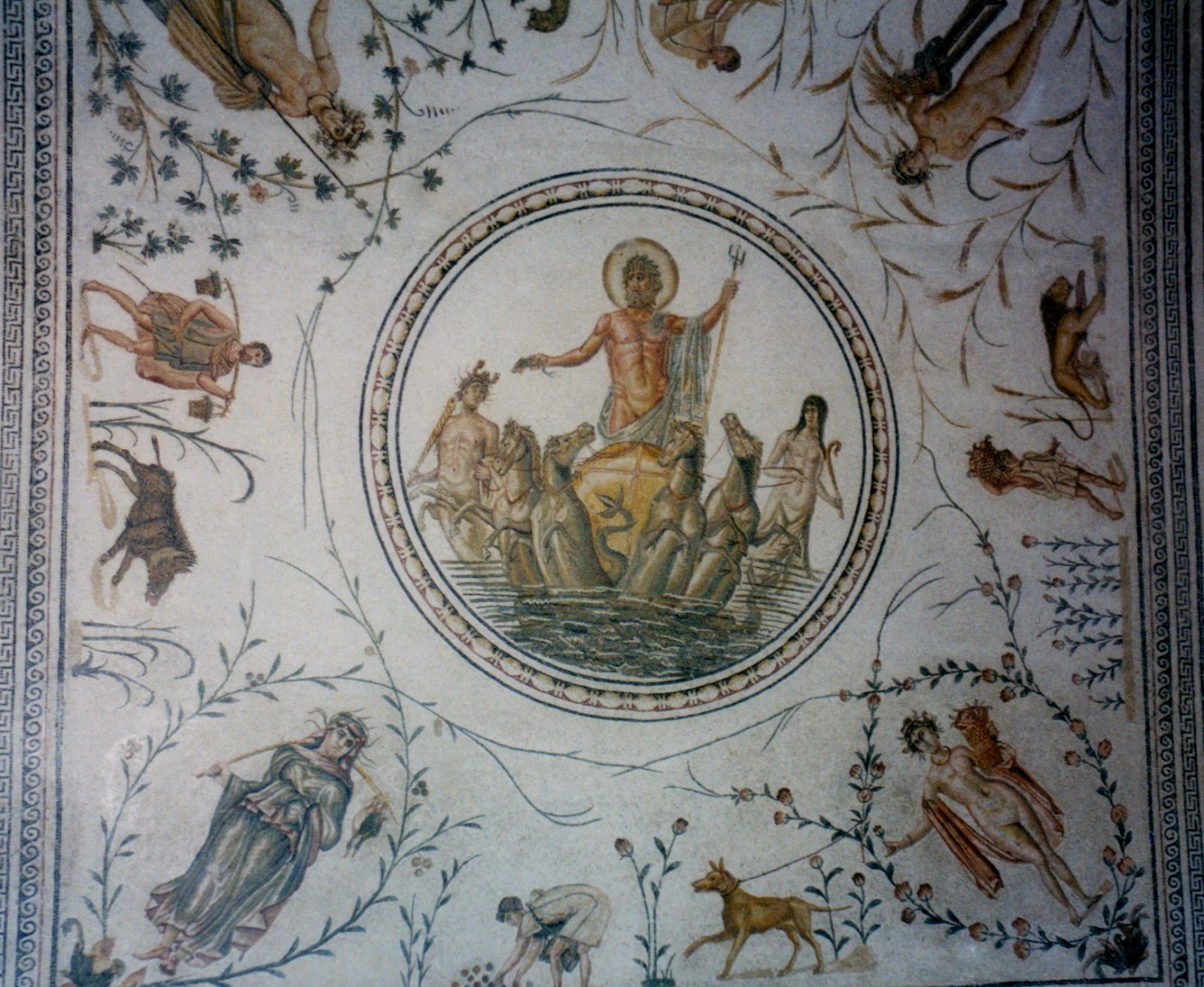
Triton in his Sea Chariot

For a writer of historical fiction, and for an historian, the museum is the place to go for research.

Not only can you learn a lot about people and places, you can also come face to face with the possessions of the people and places about which you are writing. You can interact with the items that decorated and served long-ago worlds – Egypt, Babylon, Greece, Carthage and Rome etc. etc.

In a museum, culture is frozen in time as a sort of gift to future generations, a window to peer through and better understand those who went before us.

I’ve been to a lot of museums in my travels, large and small, great and not-so-great. But there was
Hall of the old Bardo Museum
always something to be learned, something to take away with me that I could use in my writing.
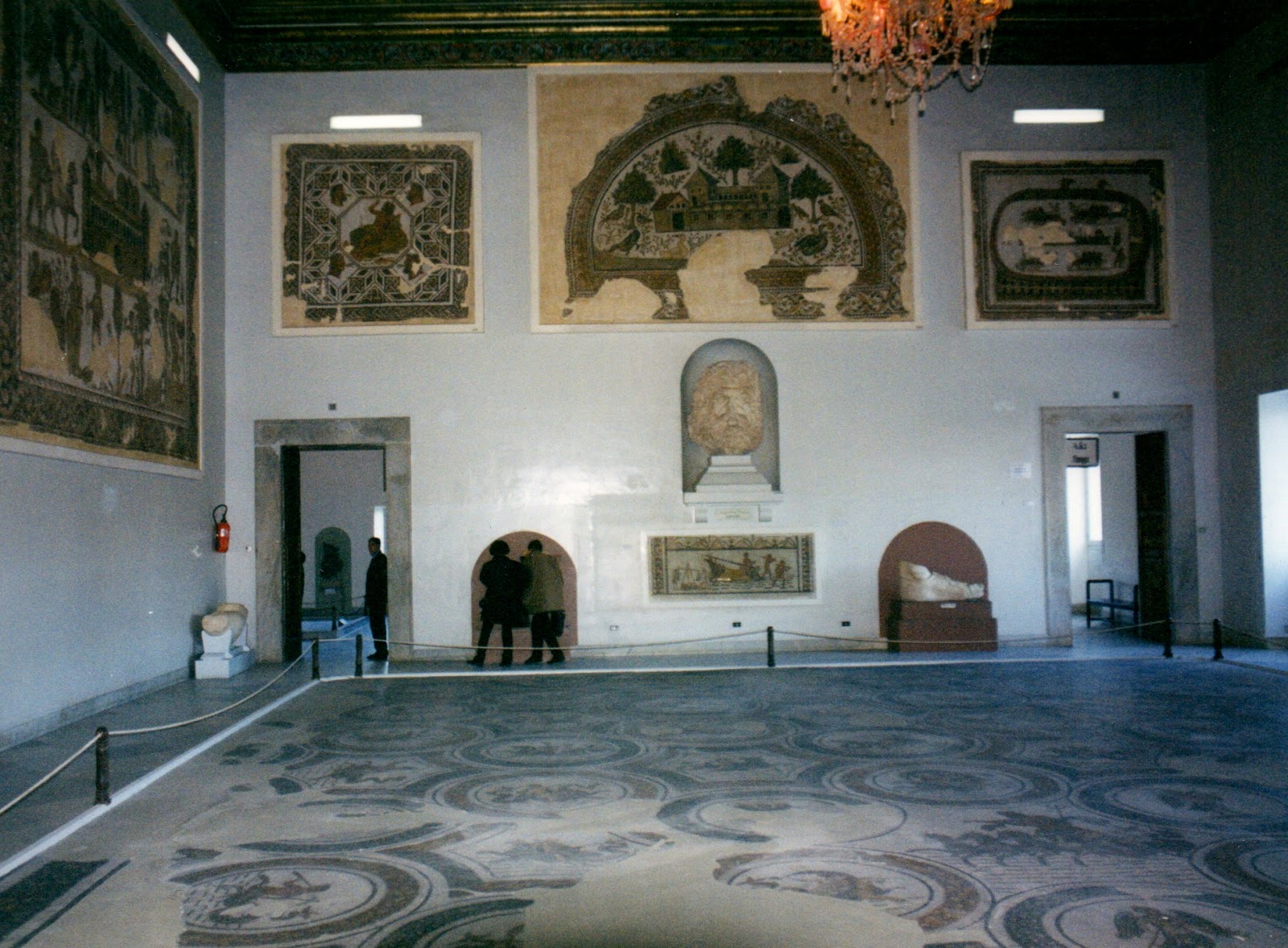
This post, I wanted to touch on a particularly wonderful museum that I visited in Tunisia – The Bardo Museum in Tunis.

When I went to Tunisia to do research for Children of Apollo and Killing the Hydra, visiting Punic and Roman sites on the fringes of the Sahara was one of the biggest thrills of my travels.

When our 4x4 left the desert behind, I was disappointed to be back in the city. Tunis held none of the allure of the southern desert or the fertile green hills of central Tunisia. There were no ruined temples or amphitheatres, no mosaics or ancient streets as open to the sky, unsuffocated by modernity.

Ulysses on his Voyage
We pulled up outside a rather unassuming building and were told this was the ‘famous’ Bardo Museum. I probably rolled my eyes, remembered swaying palms and Saharan sand beneath my feet. I dreaded the dark building before me after so much perceived freedom.

I was so wrong. When we entered the Bardo, my eyes fell upon some of the most magnificent artistic creations I have ever seen.

The walls and floors were absolutely covered with myriad mosaics of such colour, such intricacy – I thought the images would jump right out at me.

And they were tucked away in this little museum that, up until that point, I had never heard mentioned
The 'Days' of the Week
by anyone at university or elsewhere.

I decided this week to look back over some of the photos I took at the museum and enjoyed revisiting those moments when I locked eyes with a tesseraed Triton or the striking statue of a Roman woman.

When I looked at the website for the Bardo Museum, I found that they have moved to a completely new, more spacious building. Here is the link where you can also take a virtual tour of the new Bardo.

The new museum is stunning but for me the mosaics still take centre stage.

A Hunting Scene (left) and
the Nine Muses (right)
What is amazing about these creations is that they were what decorated the homes of the people who inhabited the period about which I was writing.

The visual that these mosaics provided for me and my written world was priceless.

Suddenly, my characters’ homes no longer contained shabby dirt or terra cotta floors, or even plain marble. Triclinii, peristylii and atrii came to life with the mythological and natural scenes that decorated Roman homes.

But these mosaics at the Bardo, and elsewhere, do not only depict the religious or fanciful aspects of belief.

A Gladiator and a Lion in the Arena
More importantly to our knowledge, they depict the everyday activities of people ages ago. We see people hunting, fishing, tilling and bringing in the harvest. We see images of the food they ate, the sports they watched and the heroes they worshiped.

These mosaics tell us so much about a world that would otherwise be lost to us. Thanks to these masterpieces, we know more about the buildings they decorated and the importance placed upon particular rooms within private homes, public and religious spaces.

Champion Chariot Horses
When I stepped out of the Bardo Museum into the setting sunlight on a Tunis street, I felt as though I had been a guest at sumptuous banquet in someone’s home, far off on the edge of the Empire. This was not some flee-infested frontier region. No.

The Roman provinces of Africa Proconsularis and Numidia yielded not only the oil, grain and garum upon which the Empire depended, but also artistic treasures that have left a mark on time.

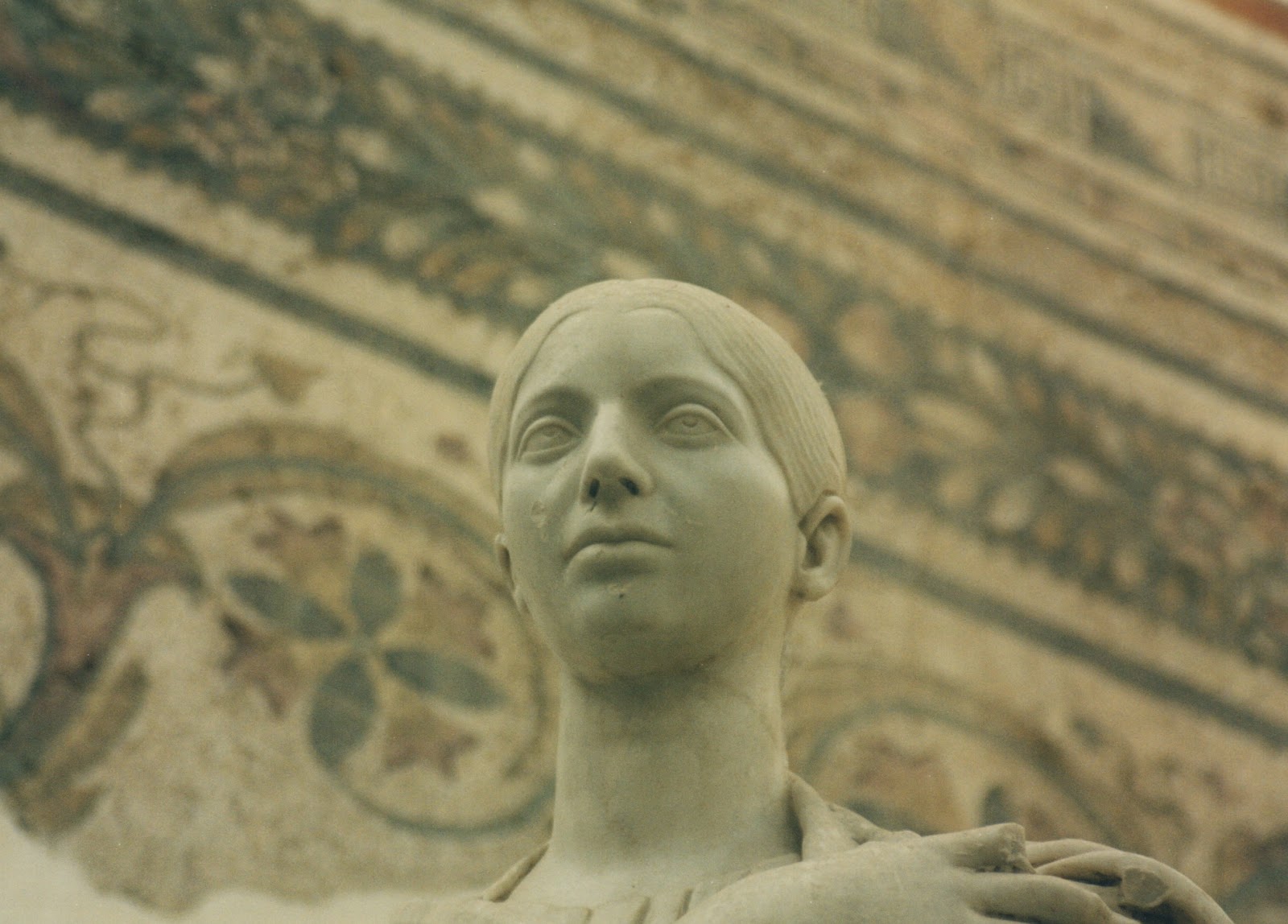
At the Bardo Museum, you can walk among these treasured mosaics with many silent, sentinel statues as your fellow guests.
If you ever get the chance to visit this place, do so. You will not regret it, and the memory of what you see will linger with you for years to come. 
Gallery Statue


Floor to Ceiling Displays

The Poet Virgil

Sunday, March 6, 2011

The Etruscans

6th Century B.C. Etruscan Tomb
Castellina in Chianti
If Indiana Jones were a hoarder, his office would probably look like mine. Actually, I don’t hoard things but my flat is not large and the historian in me has a great many books. I suffer from an ailment common to many historians and writers of historical fiction, something called "I might need it someday" syndrome, also known as "That might come in useful". This involves the need to keep close all the precious books one has accumulated over years of study, even if one never reads them all cover-to-cover.

I was undertaking my own little excavation the other day in my office when I unearthed some more photos from a vacation in Tuscany back in 2002. These photos were of an Etruscan tomb just outside Castellina in Chianti. The site was simple and unassuming but had a great impact on my imagination, so much so that I used it in some parts of Children of Apollo. On that trip, I started to learn more about the Etruscans who inhabited the Italian peninsula from roughly the Tiber to the Arno rivers and beyond to the Po valley and Bologna.

Not a great deal is known about the Etruscans and I am by no means an expert but from what I have seen and read, it is a very interesting topic. Anyone who has studied ancient Greece and Rome will have had some contact with the Etruscans; the Greeks traded with the Etruscans and were a great influence on Etruscan art and lifestyle and Rome itself was ruled by Etruscan kings who brought that little backwater village by the Tiber out of the mud with a dash of civilization. In Tuscany itself, there are many sites where one can find remains of Etruscan civilization, places such as Cerveteri, Veii, Tarquinia, Volsinii, Volterra, Vulci and Arezzo.


Etruscan Tomb Painting
Tarquinia
 Much of what is known about the Etruscans and their lifestyle comes from their tombs where elaborate paintings of banquets and sporting events such as the Olympics have been found. Many grave goods have been found in the tombs and there is an excellent collection of finds at the Archaeological Museum of Bologna (www.comune.bologna.it/bologna/Musei/Archeologico/). The Etruscans traded a great deal and so had much contact with the Greeks from other parts of Italy, Sicily and mainland Greece. The walls of the tombs depict chariot races and elaborate banqueting scenes with diners reclining on couches, drinking wine from kraters and being entertained by musicians. The scene is like many an ancient Greek depiction with one marked difference. In Etruscan art, women were shown dining right alongside the men, drinking wine and enjoying conversation. This would have been scandalous to an ancient Greek as women the other side of the Ionian sea were not permitted to be in attendance at banquets or symposia.
Chimera of Arezzo
Florence Archaeological Museum

The Etruscans had their own rich culture and this is reflected in much of their bronze artwork and pottery. While some of it resembled ancient Greek art, or indeed was Greek art acquired through trade, much of it is quite unique and an excellent example of this is the famous Chimera bronze on display at the Florence Archaeological Museum (http://www.firenzemusei.it/00_english/index.html).
There is much debate about the origin of the Etruscans in Italy with no consensus yet in sight. Some believe the Etruscans were an indigenous people, others that they came from Lydia in Asia Minor. As far as the Roman scene was concerned, the line of Etruscan kings began circa 616 B.C. with the reign of Tarquin the Elder who was a Corinthian Greek named Lucumo who lived in Tarquinia and married an Etruscan woman named Tanaquil. The two were shunned for a mixed marriage and so moved to the growing centre of Rome where Tarquin became the fifth king of Rome. The Etruscans were famous for their understanding of augury and prophecy, religious practices which would be widely used in Roman life for hundreds of years. Etruscan augurs would read portents and the will of the gods in animal entrails and organs and this skill impressed the Romans. The Etruscans not only complemented Roman religious practices but also helped to improve Roman building practices and it is to them that the Romans owe their talent for building aqueducts and sewers.

At the peak of their power and influence, the Etruscans were the dominant people of central Italy. They were however, never a truly unified nation and like the Greeks who had influenced them and traded with them, their city-states never stopped fighting amongst themselves. With the Romans growing in strength and skill to the south and the Celts expanding in the north, the Etruscans were in a superbly unenviable position and could not hold sway for long. The last Etruscan king of Rome, Tarquin the Proud, who according to Livy took the throne by force and ruled through fear, was narrowly defeated in a series of battles between Etruscan allies and the Romans, led by Lucius Iunius Brutus. Many died on both sides but Tarquin lived through the day and, though no longer King of Rome, lived out his days in exile in Tusculum. The wheels had been set in motion and Rome had become a Republic.

Of course, when I walked into the cypress-crowned tomb outside Castellina in Chianti nine years ago, I knew nothing of Etruscan history, nor how fascinating it really is. This short blurb is such a tiny scratch on the surface, a mere taste, there is so much more to learn. There are not a great many books (fiction or non-fiction) on the subject, at least not in English. As far as historical fiction/fantasy, two great reads are Steven Saylor's Roma, part of which takes place during Rome's infancy, and the other book is Ursula K. Le Guin's wonderfully woven tale, Lavinia, which looks at the early mythic establishment of Rome and the arrival of Aeneas after the Trojan War. I highly recommend the archaeological museums of Florence and Bologna where you can see Etruscan artefacts for yourselves and it goes without saying that visits to the archaeological sites mentioned are well worth the adventure. Just remember that snakes, as well as tourists, like nothing more than a dark, damp tomb in summer time.


Interior of Etruscan Tomb
Castellina in Chianti