Thursday, November 11, 2010

Remembrance for All

Poppies
Today is the 11th of November, Remembrance Day here in Canada (the 14th in the UK). This is a day to think on the sacrifices of men and women in the armed forces now and in the past. Remembrance Day is not only about World War I and II but also Korea, Vietnam, the Gulf Wars, and Afghanistan. It is about remembering those who have served in any conflict of nations.

When I went to Remembrance Day ceremonies at Queen’s Park in Toronto this morning, I was happy to see so many people present. As ever, it was a solemn occasion blessed with sunlight and crisp autumn air. The bugle sang out sadly and when it stopped, four artillery cannons commenced firing. The sound of just one of those cannons going off was shocking to say the least and I tried to imagine, in vain, what it must have been like for any soldier when there were literally hundreds of those things going off. For troops to push on to the next trench, or take a hill, with cannons thundering all around, well, it must have taken a rare form of courage.


D-Day Invasion - Normandy

Warfare plays a prominent role in human history and is something that historical novelists write about a lot, something that readers are thrown into. I remember reading John McCrae’s poem In Flanders Fields in grade school and I still wear a poppy this time of year. Like so many others, my grandfathers served in both World Wars – one with British forces under General Allenby during WWI and the other with the Greek Merchant and U.S. Navies dodging German U-boats in WWII. I wish they had lived longer so that I might have learned more from them, and though most of their stories are lost to our family, I still remember. Just because a conflict fades farther into the past does not mean that its importance is diminished in any way. War is ugly, no doubt and despite the Homeric ideals that have lived on for thousands of years, there is nothing romantic about another soldier’s brains exploding next to you.

There are countless novels and films about the World Wars, Vietnam and other modern conflicts. But, as this is a blog about historical fiction in the ancient and medieval periods I have a few recommends about turning point conflicts in the more distant past.

As far as historical battles go, the Battle at Thermopylae (480 B.C.) stands out over the ages as the true measure courage and sacrifice. When the Persian king, Xerxes invaded Greece he was met at the narrow pass of Thermopylae by 300 Spartans and 700 Thespians. The Greek forces delayed the Persians long enough for the rest of Greece to rally its forces – they all perished. For a good novel about this conflict, check out Gates of Fire by Steven Pressfield.

Monument to the 300 Spartans at Thermopylae
When it comes to Alexander the Great (356-323 B.C.) opinion is divided and differing theories are rampant and hotly debated. Was he a hero or a butcher? Was he the greatest general in history or was it is his father, Philip who should lay claim to that title for having created the army Alexander used? The questions go on and on. One thing is certain, Alexander’s campaigns ushered in a new golden era in which not only warfare and siege craft flourished but also, art and learning and technological advancement. Alexandria became the greatest city of the ancient world where the brightest minds gathered at the greatest library ever known. Some say that Alexander’s goal was to spread Hellenic culture to the rest of the world and so unite it. This might seem impossible with the violent sieges of Tyre and Gaza but then, he was also welcomed as a liberator in Egypt and Ionia and when he went east, he adopted many of their customs and traditions as his own. Alexander is one of the most complicated personages in history and I doubt that anyone will ever nail down who the man was exactly. A good series of books on Alexander is Valerio Massimo Manfredi’s Alexander Trilogy which looks at Alexander’s life from childhood to his death in Babylon.
If you are looking for a pivotal war in the Roman period, there are several to choose from, but the one that stands out for me because of a trilogy of novels is the second Punic War against none other than Hannibal. Carthage was dealt a humiliating blow by Rome at the end of the first Punic War and there was much hatred on both sides. Hannibal met his match in the person of Scipio Africanus on the plain of Zama (206 B.C.), in modern day Tunisia. The trilogy of books (Hannibal; Scipio; and Carthage) by Ross Leckie is an excellent read that I highly recommend. He manages to make us sympathetic to both sides of the conflict and a most interesting way.

Those are just a few recommended reads from me. I don’t really have any that deal with the wars of our modern age to suggest. When it comes to reminding myself of the World Wars, for example, I turn to films like Patton, Saving Private Ryan, The Thin Red Line or The Guns of Navarone. Even Captain Corelli’s Mandolin, based on the book by Louis de Bernières is a great film that sheds light on a bit of little-known history of the war on the Greek island of Cephalonia. Everyone has their favourites.

So, today, I raise my cup to the fallen heroes of the past and present. To my grandfathers and grandmothers who suffered and fought through the World Wars, to my cousin who lost her brave husband so recently in Kandahar, one of the cities founded by Alexander himself.

To the glorious Dead, thank you, now and always….

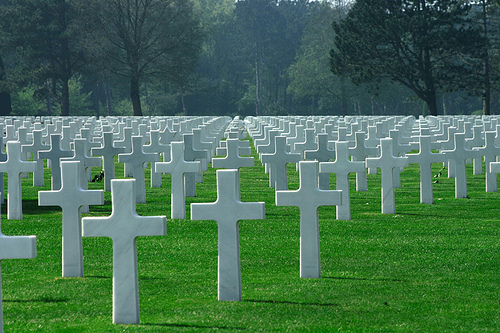
Normandy Graveyard for American Troops

Memorial at Thermopylae

Thursday, October 21, 2010

Wine-Dark Sea Battles

 Today I read about the discovery of what experts believe is a Carthaginian warship ram discovered off of Sicily that is thought to date to a sea battle of 241 B.C. between the rising Roman Republic and Punic Carthage. This was the First Punic War which ended with a treaty in 241 B.C. Here is a photo of the bronze ram that was found and which is a remnant of the last great naval battle of that war:

For a writer, sea battles can provide a very different setting for engaging enemies. The sights, smells, sounds and weapons are not always those that will paint a picture of battle on land. A good example of a small scale, ancient sea battle can be found in Gillian Bradshaw’s historical novel set in ancient Greece entitled The Sun’s Bride. This book has some great sequences and while they are not the large scale battles that no doubt marked the First Punic War, they will give a good idea of what was involved.

A good resource for research on ancient war ships if you are interested is the Trireme Trust (www.triremetrust.org.uk/). In 1987 this group built a full scale, working trireme and carried out numerous experiments to prove or disprove various theories related to the most common and deadliest of ancient war ships, the trireme. The ship itself, known as the Olympias, has been in movies and events in both Britain and Greece. In the summer of 2012, the trireme will be in New York City harbour as part of the tall ships exhibition and will be accompanied by an exhibition on Athenian maritime history at the South Street Seaport Museum (http://www.trireme.org/).

So, if you want to add a little salt-sea flair to your writing, a battle scene with a twist, get your sea legs on and get your men on board ship. If your legionaries are not comfortable at sea, remember the Roman invention of the corvus, the spiked boarding plank that the Romans invented during the First Punic War that allowed infantry to fight as though they were on land when at sea. Things were likely just as bloody. If you like movies, check out The Odyssey with Armand Assante and Greta Scacchi or Jason and the Argonauts with Jason London, Natasha Henstridge and Derek Jacobi. Both of these are great fun to watch. Just remember to offer up something to Poseidon or you could find yourself adrift.


Click to view full size image
Ancient Greek Trireme


Monday, October 11, 2010

Imperial Feast

Feasting has always played an important role in the ancient and medieval worlds as well as today. Feasts were celebratory, religious and sacrificial, in honour of various gods and goddesses and other sacred occassions.

Today is Canadian Thanksgiving, so, for all you Canadians out there, Happy Thanksgiving. Our own table was overflowing with food last night and the wine was certainly flowing, perhaps not in Dionysian proportions but enough to bring a rosy hue to our cheeks. Our sacrifice was a large turkey that fulfilled its role admirably and will provide lunchtime sandwiches for a week.

The ancients did not have turkeys on their tables but they had countless feast days. A recommended read is the Handbook to Life in Ancient Rome by Adkins and Adkins which has a wonderful chronological list of all of the feast days celebrated in the Greek and Roman world. But what did they eat?


The Classical Cookbook by Andrew Dalby and Sally Grainger
Well, if you are adventurous in your culinary explorations, you may want to check out The Classical Cookbook by Andrew Dalby and Sally Grainger. This is a wonderfully varied cookbook that contains everything from really easy dishes like chicken stuffed with olives (my favourite!) to more exotic, quirky meals like rock eel with mulberry sauce. Whatever recipe you choose will help you to feed or frighten friends and family. It will also help you writers out there with your research and will add some texture and taste to you dining scenes. The book is well researched, the writers having taken the recipes within from a range of classical texts that describe dishes from such ancient cooks as Marcus Gavius Apicius (inventor the hamburger during the reign of Tiberius).

There is a lot more food and history to be had in this book as well as others that will add a historical twist to any feast. So, if living history is the thing for you, why not step back and try out a feast ancient Greek or Roman style. Could be that your next Halloween, American Thanksgiving or Christmas feast will have people talking for quite some time. Cheers!

Wednesday, September 22, 2010

Eleusis to Avalon


Harvest symbols at Eleusis

The Autumn Equinox is here and there is a full, waxy moon glowing above Toronto. In the city it is a bit difficult to feel a connection to harvest, our rural roots having been eclipsed long ago by fast, urban living.
In a small effort to reconnect with the earth and our western ancestors who were bound to it, I thought I’d mention a couple of traditions around what has for thousands of years been an extremely sacred time of year for many cultures. Of course, this is the time of year for Thanksgiving (earlier in Canada than in the USA) when we sit around the table en-famille and stuff ourselves like the turkeys that grace our tables. And wine, oh yes, and lots of it for the oenophiles among us. But where does all this come from? Not the pilgrims, I can tell you that.

Apart from this being the night when Summer gives way to Fall, when the length of day is equal to that of night, this time of year is also Harvest time. In ancient Greece it was the month of Beodromion and the festival Apollo, the time for one of the most sacred rites: The Eleusinian Mysteries. The Mysteries were of course, in honour of the Goddess Demeter who was associated with crops, fertility, harvest and the protection of marriage. The Mysteries also honoured Persephone, Demeter’s daughter who would go to spend half the year in the underworld with Hades. The time of harvest is associated with the death of agriculture and Persephone’s time away from her mother, the time Demeter would weep, wintertime.


Goddess Demeter
 "Queenly Demeter, bringer of seasons and giver of
good gifts, what god of heaven or what mortal man has rapt away
Persephone and pierced with sorrow your dear heart?  For I heard
her voice, yet saw not with my eyes who it was.  But I tell you
truly and shortly all I know...

(from Hesiod's Hymn to Demeter - Hecate to Demeter)

...But grief yet more terrible and savage came into the
heart of Demeter, and thereafter she was so angered with the
dark-clouded Son of Cronos that she avoided the gathering of the
gods and high Olympus, and went to the towns and rich fields of
men, disfiguring her form a long while."

(from Hesiod's Hymn to Demeter)

The cult of Demeter and Persephone existed for over one thousand years and Eleusis, one of the most sacred places of ancient Greece was where the highly secretive ceremonies would take place in September and October. Sparse details about the ceremonies include bathing in the sea, sacrificing a piglet (not a turkey!), various sacred, secret objects and a procession from Athens to Eleusis.

The site of Eleusis is itself an amazing archaeological site that is well worth the visit if ever you have the opportunity. Apart from the vast complex of temples, and other remains, you can see the cave where Persephone supposedly descended into the Underworld, a door to Hades. Facing the dark entrance is a well known as the “Tears of Demeter”, thus named because of the goddess’ weeping in that spot. All quite moving.

The Door to Hades

Let us not dwell too long in ancient Greece however, for our Celtic ancestors in Europe also revered this time of year. To the Celts, harvest time was also known as Alban Elfed (Welsh for ‘Light of Autumn’), and the Feast of Avalon (Feast of Apples) among other names.

To the Celts, this was the time of year when the acorns fell from the sacred oaks and the last sheaf of wheat was cut by a young maiden. It was a time of reverence and thanks for the Earth’s bounty, a time to harvest once more and to slaughter animals before the onset of winter. An offering of apples would often be placed on burials to symbolize rebirth, hence the Feast of Avalon, Avalon of course being the ‘land of apples’.


Glastonbury Tor - 'In insula Avalonia'
 Harvest time, to the Celts, also preceded the sacred festival of Samhain which marked the end of the light of summer and the beginning of winter’s dark. Again, the cycle of light and dark, birth and death is an ever present arch-type, a cycle of which our ancestors were keenly aware and for which they had a deep respect.

So, as we sit to our laden tables this autumn, perhaps we should tip a bit of wine to the goddess who wept for her daughter’s departure into darkness, for the end of light. When the harvest moon shines down on us in all its luminescence where we live in a world of concrete floors and steel girders, think on our forest and field-dwelling ancestors, those who looked up at that same moon for ages from the dark circles of their sacred groves and gave thanks for all they had.

Thursday, August 12, 2010

Oh Behave!


I quote Austin Powers. Yes, Austin ‘Danger’ Powers who is known to have said this occasionally when an erotic comment escaped some vixen’s lips on the silver screen. You’re right, absolutely nothing to do with ancient and medieval history or historical fiction. However, those two words not only denote Austin’s curious interest in the lewd but taken together they can also bring about a question:

When writing historical fiction, how much detail should one put into scenes that contain sex and nudity, be it a loving scene, a highly charged moment or in some cases, a scene of sexual violence? Opinion is divided, certainly in my own writers’ group. But really, where does one draw the line in historical fiction before it becomes more of an historical romance or an erotica moment?

I read an article the other day in one of the writing magazines that talked about the dos and don’ts of writing fiction. One of the don’ts included not underestimating one’s readership, not explaining everything in detail but rather leaving things up to the reader’s imagination. Makes sense but I am sometimes surprised, and not in a good way, by some of the things I read in historical novels; things like detailed rape scenes just don’t do it for me. They feel like the only use is for shock value. We know that rapine was a fact of the ancient and medieval worlds but such a heinous act, and the psychological effects upon the victim, can be related to a reader without going into the minute details of the whole thing. People know what it is and for most, the mere implication of such a thing happening is enough to convey the message.

One time, when I was looking for some new historical fiction, I picked up a novel set in the dark ages and began to read the first page. I had read one good review about this particular author so I thought I would check it out. To my horror, the very first scene was of a young woman being impaled upon a stake and it described in gory, perverted detail how here clothes were lifted and the stake inserted into genitalia as a large group of men looked on. I put the book down and will not pick up anything by that author again.

I may sound a bit preachy here but that does an injustice to historical fiction. I am certainly not a prude by any stretch of the imagination but I do feel that with all the suffering in the world authors have a responsibility to convey messages that will encourage humanity to goodness. Yes, evil is present, bad things happen but spare us the details at times.

On the other hand, someone, a reader or writer, with Mr. Powers’ cheeky view on life might enjoy a bit of randy detail in a scene and why not? They did know how to party it up in the ancient world. A bit of skin shown by flute girls at a banquet could be a bit of all right. Or you could add to the intrigue by having pairs of folks coupling in the wings while the Emperor is distracted. Sexy and dangerous. A bit of fun is good, but do we need to go so far as to see up close and personal things going in and out of other things? Probably not, this is historical fiction, not Penthouse Letters.

What about if two characters are deeply in love and you want to portray that to the reader? Remember the ‘show don’t tell’ rule but also remember not to show it all. The true love between characters will be apparent in how they interact, how they treat each other at all times, how they are when they are apart. If your two love birds are in an intimate moment, set the scene and give them a bit of privacy. The reader’s imagination will do the rest.

Basically, there are many ways to look at it, and many genres in which sexuality and violence are expressed in different ways. Historical fiction has recently garnered the respect it deserves and that momentum should be maintained – we are not writing true crime or erotica, we’re writing and reading well-researched and hopefully well-written historical fiction.

To finish off, I would like to relate an incident that occurred in one of my writing classes several years back. This was an evening class at a community centre. Everyone in the class had writing aspirations and many had short stories or first drafts of novels. The class had about ten to thirteen people in it, mostly women (old and young) apart from myself, twenty at the time, and an older English gentleman, a veteran working on a memoir. Once a week, the teacher would ask one of us to read another person’s work out loud and then everyone would provide input. My work of short fantasy had been read out the previous week so I was off the hook, content to sit back and bask in the positive vibes and constructive comments everyone had given me.

That week the teacher had selected several pages from one of the ladies’ romance novels, something set in the Wild West, complete with cowboys, banditos, covered wagons and women with names like Clementine and Annabelle.

“Adam”, the teacher swivelled her chair to face me, all the heads around the table following suite. “Would you like to read for us today?”

“Sure…” The lady sitting directly across from me was the author. As she sat there, apprehensive, wide-eyed, anticipatory, the teacher slid the sample pages to me. The teacher, I should say, did not like to read the samples ahead of time, preferring to rely on first impressions and initial impact. I accepted the pages, cleared my throat. Everyone except the author was staring at the table or ceiling, waiting for the blank canvas of their minds to be filled.

“Where the Sun Sets,” I read the title and pressed on. The setting was fantastic, romantic. The purples, golds and greens of the plains came alive and we were all drawn in. The characters were likeable, heroic, flawed, human. I tried to read well, to do it justice and glanced up occasionally to see the author brimming with pride and everyone else smiling at some far off place and time of happy memory. People gripped the table edges and chairs when the banditos rode in, grimy and destructive as in a Clint Eastwood movie. The hero, a cowboy, a cool dude with feelings, saved Ms. Annabelle from certain shame and a life of hardship when he rode after her and her captors for two days, tracking them like a wolf.

Ms. Annabelle was in danger, no doubt and we weren’t sure if the hero would reach her in time. But he pressed on. Oh yes, this author had her audience hooked. Even I forgot that I was reading in front of an audience. They didn’t care about me or my voice, they cared about the words, their rhythm, the images they conjured so magically. To make a long story short, the hero dispatched all ten banditos with stealth, skill and shear cohones. Ms. Annabelle was weeping but ever so grateful. The pair were taken care of by a doctor at the closest town. The hero insisted on sleeping outside Ms. Annabelle’s door because he wanted to make sure she was safe from any more suffering. Ms. Annabelle, unable to sleep because of the heat, the sweat and the man outside who had saved her, tossed and turned and finally went to the door.

As I read the words it started to feel warm. Something in the back of my mind said, Should I stop now? Why isn’t the teacher stopping me? I’ve read so much already! I could feel my neck getting warm. The Englishman beside me started to cough. Then, different words started to appear: sweaty, longingly, caresses, kisses and even licking. Intimate parts were being explored in the sweaty sheets of this bed on the south-western frontier. The hero stood above Ms. Annabelle who could not take her eyes off him and scanned his beautiful face, shoulders, torso and hips until her eyes fell upon… Oh, shit, do I have to read this? Really? The author stared at me and, my face red as a Roma tomato, I forced myself to finish, to get it over with.

…until her eyes fell upon his…swollen member.

“Ok Adam. That’s enough. Good reading.” The teacher sat back in her chair and I sank as far as I could go into my turtleneck, the Englishman beside going through a full-on coughing fit now. I wondered if anyone would loosen his ascot for him because was so utterly red, choked by embarrassment. “Well,” the teacher continued, “it sure is hot in here!” Everyone allowed themselves an uncomfortable chuckle. “Feedback?”

Some folks pointed out the beautiful descriptions of the landscape. Others highlighted the build-up between the characters, how they eyed each other along the wagon train but always within the bounds of propriety. The teacher nodded. I said nothing. I’d done my part. When the input from students was done, the teacher leaned on the table and smiled, looked at the author.

“This is a great romance novel, fits the genre archetypes very well but had your own unique style. Very good.” The author relaxed visibly but the rest of us knew it was coming. “However, an author should never, EVER, use the phrase swollen member.” Thank god she said it. “Leave that kind of detail to the reader’s imagination.”


Saturday, July 24, 2010

Olympic Youth

Today I wanted to draw your attention to something that many might not know about. In an e-mail newsletter I received from
the International Olympic Committee (IOC) I received a link to a video of the lighting of the Olympic Flame for the inaugural
Youth Olympic Games, a new initiative intended to get youth interested in sport and the Olympic spirit.

I love the Olympics and how it brings the world together like no other event (sorry World Cup fans!). The historian in me loves the tradition of the Olympics, the sacredness that, though today is somewhat dulled by marketing, for thousands of years was adhered to. It was something that blanketed the ancient world in peace for a time. The Olympic Games were, of course the most sacred of the four major games in ancient Greece, the other three being the Nemean Games, the Isthmian Games, and the Pythian Games.

Ancient Olympia was, and to my mind is, a most sacred place, a place of peace. I have been there a few times and, despite the hordes of tourists and idling buses outside the ancient sanctuary, I am always awed with the sense of peace that falls over my person when I set foot among the temples, columns and remnants of ancient arcades. The visitors seem to disappear and all I hear is the thrumming of cicadas in the light of Apollo’s sun. Yes, I do get carried away, but you can’t help that in a place like Olympia. When you walk the gravel pathways between the ruins, along the fallen column drums of the once-great Temple of Zeus (whose statue was a wonder of the ancient world) or walk down the barrel-vaulted tunnel to the stadium, the ghosts of past Olympians walk beside you. It is as though they are welcoming you to join them on their eternal stroll through the sanctuary, whispering to you to pass on the wisdom of the Olympic spirit, warning you to respect that most sacred of places.

If you have not been to Ancient Olympia, go. It is truly a wonder and a feeling to be tapped into. And if you do go, push the bustling, noisome tourists from your mind (because not everyone gets it), find a quiet corner beneath the shade of an olive tree and listen for voices of the past, the roar of the crowds that rang out for millennia. It is truly special.

The IOC has posted the flame lighting ceremony on their website for the Youth Olympic Games and if you have a bit of time it is definitely worth watching. http://www.olympic.org/en/content/YOG/YOG-news-face/YogNewsContainer/yog-enter-history-in-Ancient-Olympia/
This will give you a taste of an ancient ceremony, undertaken with the sincerity that it deserves. The Olympic flame begins its journey here every time, lit by the priestesses of Olympia by the light of the sun that shines on this place.

It is very exciting that the Flame has been kindled in Olympia to herald the dawn of a new tradition. Good luck to the youth of the world and may Nike (Victory) be with you.


(Photo credit: Associated Press)

Saturday, July 3, 2010

Living History


Summer is now upon us and that means a plethora of outdoor events at historical sites around Europe and North America. The Ermine Street Guard and Antonine Guard in the UK as well as other Roman re-enactment groups will be out in force to dazzle spectators with precise military formations, cavalry tactics, firing of ballista bolts and replicas of everyday items Romans would have used. Members of The Society for Creative Anachronism will be touring the Renaissance Fair circuit entertaining fair goers, trading goods and washing down greasy turkey legs with pints of frothy ale. English and American civil groups will be re-enacting famous battles etc. etc. Every period of history has its own fans and enthusiasts who go that extra league to immerse themselves in an era for which they likely feel they are better suited than our current one.

These events and displays are usually a great time and in some cases highly educational. Re-enactments can stimulate interest in a particular period, further research and even help academics figure out the use of a newly-discovered artefact. Other times, its all about folks dressing up and having a great time.

For writers like myself, living history re-enactors and re-creations are an invaluable source because of the thorough research that has been done before hand and on an ongoing basis. In the case of Roman re-enactment groups, some authors have trained with them to get a better understanding of the feel, the mechanics of a certain weapon, pieces of armour and even a Roman cavalry saddle which, of course, did not have stirrups but rather four horns for bracing the thighs against. The latter is actually much more comfortable and utilitarian than one would expect.

A good friend of mine has been a member of the Antonine Guard in Scotland for several years (www.theantonineguard.org.uk - the group does regular talks at schools, documentaries and also trained the actors and extras for the new film CENTURION). When writing Children of Apollo and Killing the Hydra, I was able to read over a copy of the group’s field manual which details troop drills and all the Latin commands that were used in the Imperial Roman Army. What a great source to add detail and accuracy to a historical tale. Teachers, if you are listening, rather than having your students slug their way through the usual, dry history book, invite a period re-enactment group to your school and see what a difference it makes to knowledge retention and learning enjoyment. And while you are at it, assign your students a good historical novel!

So, next time you are out touring and you see a sign for a historical demonstration, don’t be so quick to dismiss it as a gathering of oddball history freaks. Drop in and see what it is all about. Yes, you may be confronted by a band of greasy, chicken&chips-eating yobs sporting a mish-mash of period costumes and bad accents but, on the other hand, you may also be in for a real treat, a chance to learn some fascinating facts about life in a by-gone era from people who truly value the past and accuracy in their portrayal of it.