Showing posts with label pagan. Show all posts

Friday, December 6, 2013

In Insula Avalonia - The Chalice Well

This next site In Insula Avalonia we are going to look at is one that, like the rest of Glastonbury, is suffused with layers of history, legend, and belief.

The Chalice Well and surrounding gardens, located in a valley between Chalice Hill and the Tor, is one of those places that you don’t quite know what to make of at first. When you enter under the vine-covered pergola you are met by colour, soft light, and the gentle trickle of water playing about your senses.

You see young, wildly coloured blossoms exploding from the soil at the foot of Yew trees that have seen centuries of summers in the Isle of Glass.

The same goes for the people visiting this place.

You will see young children frolicking like fairies at the edge of the water, adults of all ages contemplating beauty…life…death.

And you will find aged men and women, whose years are beyond the care of counting, strolling silently about the gardens. They’ll admire a particularly beautiful blossom or sit on one of the many benches hidden in private corners, perhaps remembering others they have come here with long ago, or just looking up at the Tor and harkening back to the tales of Arthur they loved when they too were children.

The thing about this place is its overwhelming sense of peace and harmony, from which all can benefit.

But what exactly is the Chalice Well?

Scientifically-speaking, Chalice Well is actually an iron-rich spring, the source of which is unknown. 

Some believe it comes from deep in the Mendip Hills to the north. Chalice Well is where it comes out of the ground.

Vescica Piscis
well cover
Springs were sacred to the ancient Celts. To those who inhabited this area from the pre-historic era on, the Well may have been a healing place beside the Tor. The waters that run red were sacred to the Goddess and were her water of life.

The spring has never failed, even in drought.

It is also believed that Glastonbury was the site of a Druid ‘college’ of instruction and that the avenue of sacred Yew trees, some still remaining in the Chalice Well gardens, were part of a processional way to the Tor, passing beside the Well.

Later legend, and the reason for the name given to the Well, relates how Joseph of Arimathea brought the Holy Grail to Glastonbury in A.D.37. It is said that he buried the Grail near the Well and that the water runs through it, hence the redness of the water.

The Goddess’s blood was replaced by that of Christ, and though that has changed, the sanctity of the place remains intact.

Of course, there is an Arthurian connection. Where you find the Grail, there too will you find Arthur and his knights.

In the 15th century, Sir Thomas Malory mentions the spring in his Morte d’Arthur when Lancelot and others are said to have retired as hermits in a valley near Glastonbury. Some believe it was this site that he referred to.

'The Failure of Lancelot'
Sir Edward Burne Jones
The sacred water of the Chalice Well feels like the beating heart of the gardens that surround it, and visitors, like a protective shield.

There are four places where the water surfaces in the Gardens.

The first is one of the most striking features – the Well cover in the form of the Vescica Piscis.

The Vescica Piscis is an ancient symbol that represents the intersection of the material and immaterial (Natural and Supernatural) worlds.

The Chalice Well cover is made of English oak and wrought iron, and was designed after WWI by the architect and clairvoyant, Frederick Bligh Bond, who carried out the first excavations on Glastonbury Abbey.

The difference with this Vescica Piscis is that the circles are intersected by a sword, or bleeding lance, a Christian addition to this ancient symbol of power.

From the Well, the red water flows to the Lion’s Head where people can go to drink, or sit in quiet reflection while the water splashes onto a stone below.

Farther down the Garden you come to a striking rich-red waterfall where the spring cascades down into a pool where people can soak themselves in the healing water. This pool is another place of meditation known as Arthur’s Courtyard.

After that, the water flows past two ancient Yew trees, and a growing of the Holy Thorn (yes, it survives!) into a pool shaped like the Vescica Piscis near where you enter the Gardens. The spring then flows away underground, beneath the Abbey and the pavement of Magdalene Street.

The red water’s healing sojourn above ground is fleeting, but for thousands of years it has brought people comfort, and peace.

Arthur's Courtyard
Whenever I would visit Chalice Well and the gardens, my head pounding from a migraine, or the weight of a world of worries pressing me down, I would always leave feeling rejuvenated, calm, and optimistic.

Whether visitors are pagan, Wiccan, atheist, or Christian, or they adhere to some other system of belief, the Chalice Well is a place where people still believe in miracles, as they have done for thousands of years.


Friday, November 15, 2013

In Insula Avalonia - Wearyall Hill and the Holy Thorn

Last time in this short series of posts, we looked at Glastonbury Tor.

Today, we’ll wander up the slopes of another prominent feature of the landscape that you pass as you approach Glastonbury from neighbouring village of Street: Wearyall Hill.

Wearyall Hill is, of course, home to one of Glastonbury’s most ancient treasures – the Holy Thorn.

Across the street from the Safeway, you can climb up Wearyall’s gentle slope to see a hawthorn tree known as the Glastonbury Thorn, or ‘Holy Thorn’. One popular legend associated with Wearyall Hill and the Holy Thorn is that in the years after Christ’s death, his uncle Joseph of Arimathea came with twelve followers by boat to Glastonbury. When they set foot on the hill, tired from their journey, Joseph plunged his staff into the ground and it took root.

There is actually some archaeological evidence for a dock or wharf on the slopes of Wearyall Hill that date from the period. Did Joseph of Arimathea actually arrive in Britain with the Holy Grail?

Joseph of Arimathea
Well, that depends on what you believe. And Glastonbury is just that, an amalgam of beliefs that live, for the most part, in harmony - Perhaps just as the Celts and early Christians did here around two thousand years ago?

Cuttings of the Thorn grow in three places in Glastonbury. What is interesting is that this variety of hawthorn is not native to Britain, but is a Syrian variety. Curiously, it flowers at Christmas and Easter, both sacred festivals for Pagans and Christians. Every holiday season, the Royal family is sent a clipping of this very special tree that hails from the earliest days of Christianity in Britain.

The current Thorn is not the original, but rather a descendant of the original which was burned down by Cromwell’s Puritans in the seventeenth century as a ‘relic of superstition’. How much destruction has been wrought on the ancient sites of Britain during the wars waged by Henry VIII and Oliver Cromwell? It’s horrifying to think about.

As with all other things in Glastonbury, Wearyall Hill and the Holy Thorn do not belong solely to the Christian past.

Thorn in Blossom - Glastonbury Abbey
The hawthorn tree was one of the most sacred trees to the Celts and is the sixth tree on the Druid tree calendar and alphabet. It is also known as the ‘May Tree’ because of when it blossoms most. May was sacred to the ancient Celts as the time of the festival of Beltane, a time for Spring ritual and worship of the Goddess.

In the Middle Ages, the practice of picking hawthorn boughs evolved to include dancing with them around a May Pole.

In Arthurian tradition, Wearyall Hill is associated with the castle of the ‘King Fisherman’ whom the select Grail knights meet. To reach the castle, those on the quest were said to have to cross the ‘perilous bridge’ over the river of Death. To pass through the castle was to go from this world to the next.

Interesting the think that the gates to the otherworld of Annwn were believed to be just on the next hill, Glastonbury Tor.

Whatever legend or myth you believe, or don’t believe, about Wearyall Hill is up to you. The stories are many and convoluted, but such is the fate of great and sacred places of the past.

I always looked forward to my walks up the gentle slope of Wearyall Hill with the Holy Thorn drawing me up like a beacon, a friend even. Locals, Christian and Pagan believers, hold it close to their hearts.

Holy Thorn with wishes tied to it
and Glastonbury Tor in background
Once at the top of the hill, I would circle the Thorn, reach out to touch its limbs, and read some of the wishes or prayers on ribbons tied to it – ‘Don’t let me lose my family,’ or ‘Thank you for making my mummy better.’ The wishes wrenched your heart, and the thanks made you smile.

When I would sit on the nearby bench at the top of the hill, I never felt alone. I would look out at the Tor and the surrounding landscape and feel tremendous gratitude. I would always leave with a sense of hope for the future, and a tie to the past.

I remember the last time I drove away from the Thorn back in 2002, the sigh that heaved out of my chest as I made my way back down the hill to the parking lot across the street. I looked up to see that lovely wind-blown silhouette and was somehow reassured by its presence.

Since my own days In Insula Avalonia, it seems that tragedy has struck Wearyall Hill.

In writing this piece, I thought I would check the internet for any new discoveries or theories about the hill and its archaeology.

After the vandalization of the Thorn
Instead, I found an article relating how in 2010, vandals took a chainsaw to the Holy Thorn in the middle of the night. In the morning, residents found their beloved tree of hope hacked to bits. A sapling was planted again in the Spring of 2013, but again, that was knocked down in the night.

I’m still in shock over this, having just found out. I’d been in ignorant bliss, lost in my remembrances of Glastonbury’s Thorn in full bloom on a sunlit hilltop.

I don’t know what would drive people to such destruction other than pure ignorance or malice. Part of me wants to devise ways in which the perpetrators could be made to pay, but then that would go against everything the Holy Thorn stands for.

Either way, if you mess with god, goddesses, fairies or Gwynn ap Nudd himself, you’re likely to get your comeuppance no matter what your beliefs.

But the Thorn has survived the centuries and there has been talk that new shoots have been coming up. The Royal Botanical Gardens is on the case, and so are the citizens of Glastonbury.

The Thorn and Wearyall Hill itself are not purely Christian or Pagan. They are symbols of unity, and of a common past. We should indeed cherish sites that are so revered, whether we believe in them or not.

In a way, the Thorn’s sacrifice is bringing people together. Glastonbury is still a town where Pagan and Christian live side by side.

I have every hope that the Thorn will blossom once again on the crest of Wearyall Hill, and that one day I’ll make the climb to say hello to a very old friend.


Thank you for reading.


Monday, December 24, 2012

History of the Holidays

Holly Wreath


Season’s Greetings everyone!

It is indeed that time of year again. The wheel of time has turned round once more and we find ourselves at the Winter Solstice. It is a time of celebration, of gathering and merry making. It is a time of giving and gratitude. For many of us, it is Christmas time.

I always feel a great connection to the past at this time of year and not only the Christian past. The traditions of this time reach much farther back than the beginnings of Christianity. Over the millennia this very time of year has been held sacred and special by many ancient cultures, celebrated in many different ways.

We have more in common with the past than we often realize.  

As I sit by the tree in my living room, the soft glow of a thousand coloured lights gracing the paper upon which I write, I feel a common thread of tradition with those that have gone before, and those that will come long after I am dust. There is a comfort in that. 

Traditions are important for all people, all cultures. And so, I wanted to look at a few of the varied traditions of this festive season from which most of us derive some form of jollity. 

Marduk
In ancient Babylon the Festival of Marduk, the god whom the Babylonians believed created the world, was celebrated at this time of year. The festival involved a twelve day feast during which time gifts were given and people visited the homes of friends and family. Sound familiar?

In the Roman Empire, the big festival at this time of year, indeed one of the biggest of the entire year, was the Festival of Saturnalia which began officially on December 17. Saturn, of course, was the Roman god of agriculture, of liberation, and of time. Fitting that the Winter Solstice festival, the time when the days would begin to get longer and the winter stores of food were used, was dedicated to him. Time moves on. 

Saturnalia was a major party for Romans. There was always lots of food, drink and gift-giving. Gifts were often small and inexpensive and included things such as lucky fruits or cakes. Saturnalia was a definite carnival atmosphere, especially for slaves for, as Saturn was also a god of liberation, for one day, slave and master exchanged roles with the masters serving the servants. Everyone could let loose. Indoors, many candles were kept burning during this darkest time of year and green boughs were hung within and without people’s homes. 

Saturnalia in Ancient Rome
Many believe the Greek festival of Kronia, a harvest festival dedicated to Kronos in July and August was the major influence on Saturnalia. At the Kronia, there were feasts and banquets and games. There was also freedom from work and social equality for a day which represented a ‘Golden Age’ in which there was total harmony, no slavery or hierarchy. Slaves were released from duties during part of the Kronia just as they were during Saturnalia. 

And of course, as with any ancient festival, offerings and sacrifices were made to the gods. The religious roots of these celebrations cannot be overstated. Ancient peoples believed the gods played a role in every aspect of daily life and each was honoured. That is one reason there were so very many festivals in the Greek and Roman calendars. 

Mithras and the Tauroctony
A couple of blog posts ago, I wrote about Mithras, Lord of Light and Truth, and now we return to him. The Persian god Mithras defeated the darkness for Ahura Mazda and in mythology, his birthday was December 25th. As a god of Light, equated with Sol Invictus, the ‘unconquered sun’, it is no wonder that the Winter Solstice, the time when the sun is reborn after the darkest days, was dedicated to Mithras. Saturn also played a large role in Mithraism as this was the name given to the highest grade of initiate in the religion – Saturn was the ‘Pater’. 

Other pre-Christian gods of light, merriment, and abundance were said to have been born during December as well, including Dionysus and the Hebrew/Phoenician god, Baal. 

Mistletoe
The Winter Solstice was a very sacred time of year and this seems to be the most common thread through time and religions. The worship of the rising Sun, the time when the eternal Sun begins to get higher in the sky, making the days longer, warming our lives. 

At Christmas, I like to hang cedar in our home, as well as boughs of holly. It is beautiful, atmospheric, warm and sweet smelling. It is also a tradition that was practiced by the ancient Celts and Druids for whom nature was so important. 

The Celts believed holly and mistletoe were sacred and that they housed good, protective spirits. At this darkest time of year, this was important. Boughs of cedar and oak and other sacred trees were hung, often in the shape of wreathes which represented the round eternal, self-renewing sun. Even today, people gather at monuments such as Stonehenge to witness the Winter Solstice sunset, branches in hand. 

Winter Solstice at Stonehenge
Moving into the Middle Ages, we come next to the Norse and Saxon traditions of northern Europe which also filtered into Britain and with which many of us are familiar today. 

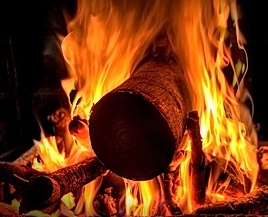
Yule was originally a pagan festival associated with the god Odin and the Wild Hunt. Before Christianity spread among the Saxons, the festival involved things such as a Yule Goat, a Yule Boar, Yule singing and of course, the Yule Log which was brought home with great ceremony and intended to burn long and bright during this dark part of the year. 

The tradition of Wassailing is, I find, one of the most interesting remnants of the pagan past. It was particular to the south west of England, especially Somerset. For hundreds of years, the people of this apple-producing region would walk out with their named King and Queen of Wassail, each with a cup of the mulled cider or ale of the same name, to sing songs to the apple trees and wood spirits of the orchards. 

Yule Log
Where I used to live, just outside of Glastonbury, Somerset, we lived among some orchards. I used to walk among the trees in the early winter mornings when the sun would rise and the branches and bushes would sparkle as the light weaved its way among the frost-encrusted world. It is an image I hold dear and I can remember wondering what it would have been like to have taken part in the singing of the Wassail songs where they were meant to be sung. 


 Many of these songs remain a part of today’s Christmas carols. Here is part of one of my favourites which dates roughly to the late medieval period:

Here we come a-wassailing
Among the leaves so green,
Here we come a wand'ring,
So fair to be seen.

Love and joy come to you,
And to your wassail too,
And God bless you and send you a happy new year,
And God send you a happy new year.

These are but a few of the long-standing traditions that we revisit year after year in some form or another, whether it is reverence for our various gods, gratitude for the birth of the Sun, or of the Son, feasting, merriment, decorating our homes and filling them with song.

This is a time of year to be enjoyed, to be grateful and charitable toward each other and our world.

So, as I raise my cup and my voice along with my family and friends this holiday season, I will also raise them along with all those who have gone before. From the ancient to the medieval and modern worlds, from the sacred forests of the Celts to the simple table at which we sit today, I remember the past and present and that, for ages, this has been a time of year when Light overcomes Dark and gods have been born. And so, the wheel of the year turns. 

To you and yours, whatever your faith or beliefs, I wish you a brilliant Winter Solstice and a Happy Christmas and New Year!

Cheers!